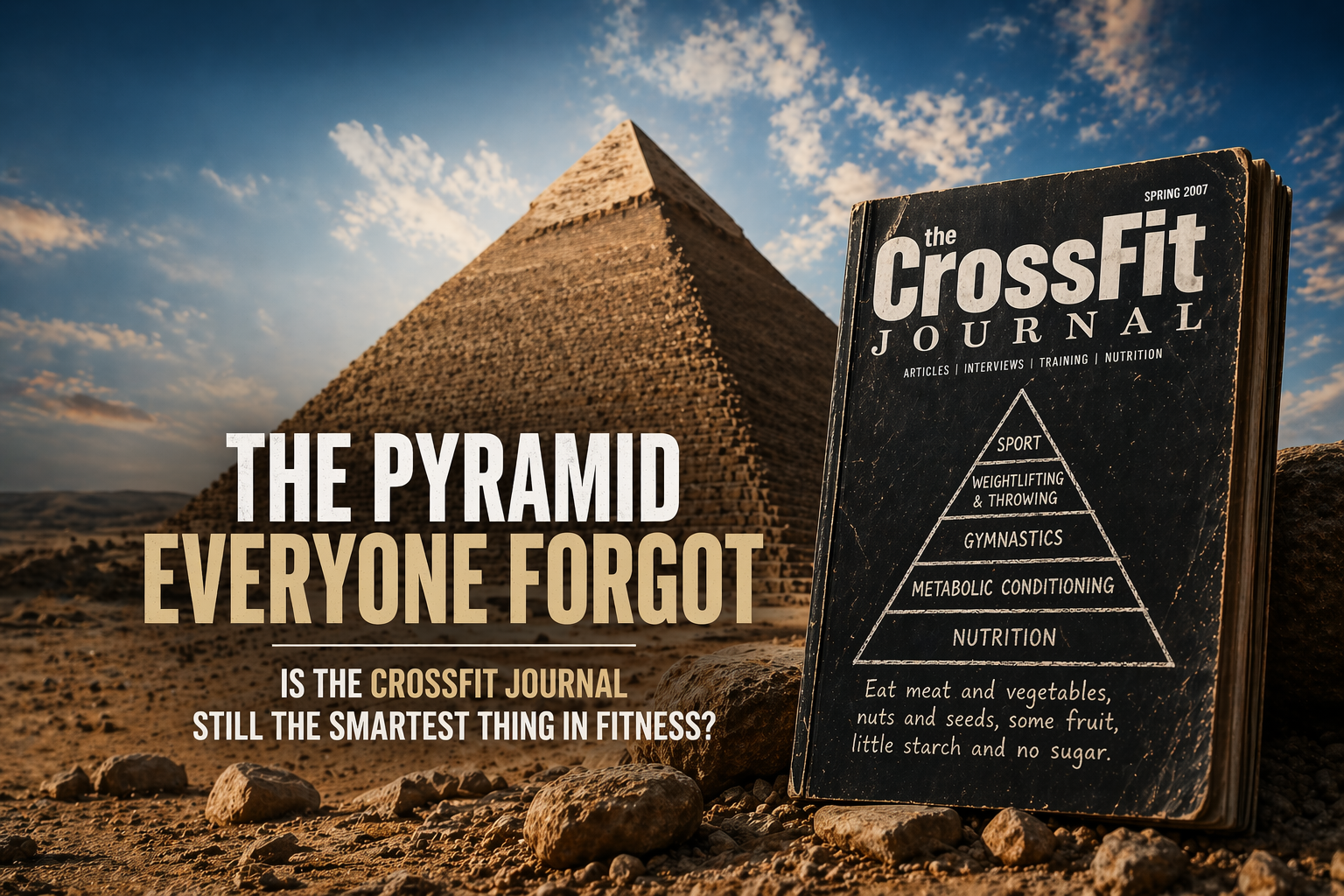
The Pyramid Everyone Forgot
Opinion
Is the CrossFit Journal Still the Smartest Thing in Fitness?
I was thirty-six when my body stopped making sense to me.
The weight came on like someone had flipped a switch — ten pounds in a month, then twenty, then a number I stopped looking at. I was exhausted by noon. My sleep was wrecked. My moods swung hard enough to scare me. I went to my doctor and got the response that millions of women get far too early and far too casually: dismissal. I eventually learned on my own that it was Perimenopause. I had no real plan. No real explanation. Just a vague suggestions online to “manage stress” and a tons of information on HRT prescriptions I wasn’t sure I wanted.
So I did what most of us do. I tried everything that used to work. Cardio programs. Calorie restriction. Meal replacement shakes. Thirty-day resets that lasted eleven days. Juice fasts. Raw Food detox. More cardio. I lost nothing. I gained more — not just weight, but a deepening belief that my body had simply betrayed me and there was nothing I could do about it. That this was just what it was going to be from that point on.
Then one night, I fell down a YouTube rabbit hole.
I was originally searching for the crazy “miracle diets”... you know the ones. “Lose 20 pounds in 30 days” (PS if that is you right now please don’t do that), but somehow I landed on a video of adaptive CrossFit Games athletes. Amputees lifting barbells And then the algorithm served me the masters athletes — women in their fifties and sixties cleaning barbells, running, doing pullups, moving with a kind of fierceness that made me sit up in bed and whisper what is this?
I watched for hours. Not the elite competitors. The everyday ones. The grandmothers. The women who looked like they’d been through some s*** and had decided, at some point, that they were done being defined by what they’d lost. I didn’t know a single thing about CrossFit methodology. I didn’t know what a WOD was. I just knew that whatever these people had found, I wanted it.
I walked into a box a few days later with fifty-seven extra pounds on my frame, no athletic background (I was a dancer in a previous life but definitely not athletic), and a hormonal system I didn’t understand anymore. I had decided, somewhere between the third and fourth YouTube video, to let go of every excuse I’d been carrying — the age, the hormones, the failed diets, the assumption that my body was a problem to be managed rather than a system to be understood.
What I didn’t let go of — because I didn’t know I was holding it — was my complete ignorance about nutrition.
I trained hard. I showed up. I scaled everything. But I was still eating the way I’d always eaten, which is to say ‘questionable’ and without any framework. I didn’t understand that training without nutritional awareness is like building a house from the roof down. I didn’t understand what perimenopause was actually doing to my insulin sensitivity, my cortisol, my ability to recover. I had the mindset piece — finally — but I was missing the foundation.
CrossFit gave me that foundation. Not just the workouts, but the methodology. The deeper I went into the community, the more I encountered the ideas that would eventually reshape how I ate, how I thought about food, and how I understood what was happening inside my own body. I lost those fifty-seven pounds. But more importantly, I learned why I’d gained them — and why no amount of willpower alone was ever going to be enough.
The thing that taught me all of this wasn’t an Instagram influencer or a coaching certification course. It was the CrossFit gym and as I drank more of the Kool-Aid the CrossFit Journal.
If you’ve been in the CrossFit world for any length of time, you’ve probably heard someone reference the Journal. You may have even read an article or two. But here’s an uncomfortable question that maybe you silently wonder but never ask out loud: Does anyone still read it? And if not, are we losing the single most important intellectual foundation the methodology ever produced?
I think we are. And I think it matters more than most coaches realize.
The Pyramid Nobody Wants to Talk About
Go ask the average CrossFit athlete what the CrossFit pyramid is. You’ll get blank stares, or maybe a vague gesture toward “nutrition is the base.” That’s technically correct, but the dismissiveness is the problem.
The CrossFit theoretical hierarchy of development — Nutrition, Metabolic Conditioning, Gymnastics, Weightlifting, Sport — isn’t a cute infographic. It’s an argument. It’s a claim about causality. It says, plainly and without apology, that no amount of snatches and muscle-ups will outrun a broken diet. That metabolic conditioning precedes skill work. That the order matters because biology doesn’t care about your preferences.
The Journal was where that argument was built, defended, and refined. Greg Glassman’s early articles — “What Is Fitness?”, “Foundations”, “The Theoretical Hierarchy of Development” — weren’t content marketing. They were position papers. They drew lines. They picked fights with the existing fitness industry and backed up every provocation with logic, data, and an almost stubborn insistence on first principles.
And yet in 2026, you can walk into dozens of affiliate gyms and find coaches who have never read any of them.
The Nutrition Problem Is a Coaching Problem
Here’s where I have to put on my nutritionist hat, because this is the piece that makes me genuinely frustrated.
The base of the pyramid is nutrition. Not “macros.” Not “meal prep.” Not whatever 75-day challenge is trending this quarter. Nutrition — as in the quality, quantity, and composition of what you eat, understood as the single largest determinant of your health and performance.
The Journal laid this out with remarkable clarity. It positioned nutrition not as a supplement to training but as the precondition for it. The famous prescription — “Eat meat and vegetables, nuts and seeds, some fruit, little starch, and no sugar” — is deceptively simple. It’s also, in my clinical experience working with clients across every age bracket, still one of the most effective starting frameworks for anyone trying to unflatten their metabolic health.
But we’ve drifted. The modern CrossFit conversation has become almost entirely about programming — percentage-based strength cycles, competition-track metcons, hyrox prep, hybrid athlete splits. Nutrition MAYBE gets a passing mention during an on-ramp class and then functionally disappears from the coaching relationship. We’ve inverted the pyramid and then wondered why so many athletes plateau, burn out, or quietly develop disordered relationships with food.
As a health coach who works primarily with women over forty, I see the downstream consequences of this inversion a lot. Women who can deadlift 1.5 times their bodyweight but haven’t had a normal fasting glucose reading in three years. Athletes who train five days a week but subsist on protein bars and cold brew because nobody ever taught them that the base of the pyramid isn’t optional — it’s structural.
The Journal addressed this. Repeatedly. With an almost annoying insistence. And it was right.
Methodology Isn’t Programming
There’s a distinction the Journal drew that I think has been almost entirely lost in modern CrossFit culture, and it’s this: methodology is not the same thing as programming.
Programming is what goes on the whiteboard. Methodology is why it goes on the whiteboard. Programming is sets, reps, and time domains. Methodology is the underlying logic that says constantly varied, functional movements performed at high intensity will produce the broadest and most inclusive fitness — and that this approach is supported by a specific hierarchy of physiological priorities.
The Journal was the home of the methodology. It was the place where the why lived. And the why matters enormously, because without it, CrossFit is just another workout format — interchangeable with boot camps, circuit training, or whatever group fitness trend emerges next season.
In the last year and a half I’ve gone back and started reading the Journal articles. What has struck me isn’t just the content — it’s the rigor. These were people who cared about defining their terms. “What is fitness?” isn’t a rhetorical question in the Journal. It’s a 4,000-word essay that proposes ten physical skills, three metabolic pathways, and a measurable standard. It’s falsifiable. It invites disagreement on specific terms, which is exactly what a serious methodology should do.
Compare that to the training content most athletes consume today: Instagram carousels with percentage charts, YouTube breakdowns of competition workouts, and AI-generated “hybrid programs” that borrow CrossFit’s vocabulary while ignoring its logic. The methodology has been diluted into aesthetics.
Why It Still Matters — Especially Now
I’ll be honest about my bias. I didn’t come to CrossFit as a nutritionist. CrossFit made me one. I didn’t start with my PhD in Functional Medicine, CrossFit made me one. At 50 years old! When I was a woman in her late thirties with a hormonal condition I didn’t understand, eating in ways that were actively working against me, and believing — because the fitness industry had taught me to believe — that the answer was just more willpower, fewer calories, harder workouts. CrossFit and the Journal was the first thing that told me I had the order wrong. That nutrition wasn’t a side quest. That my body wasn’t broken — it was underfed in the ways that mattered and overfed in the ways that didn’t. That realization sent me back to school, into clinical training, and eventually into the work I do now. So when I say you cannot out-train a bad diet, and anyone who tells you otherwise is selling you something, I’m not reciting a coaching platitude. I lived the proof.
But my bias doesn’t make the argument wrong. If anything, the case for the Journal’s relevance has only gotten stronger. We are in the middle of a metabolic health crisis. Rates of insulin resistance, type 2 diabetes, and chronic inflammation continue to climb. The average American adult now meets the clinical criteria for metabolic syndrome. And CrossFit — the methodology, not just the brand — was built from the ground up to address exactly this kind of crisis, starting with nutrition and building upward through movement quality and intensity.
The Journal is where that architecture is documented. It’s the blueprint. And blueprints don’t expire because people stop reading them.
So, Is It Still Relevant?
Here’s my answer, and I don’t think it’s complicated: The CrossFit Journal is more relevant than ever, precisely because most people have stopped paying attention to it.
The principles haven’t aged. The pyramid hasn’t been disproven. The foundational articles on nutrition, metabolic conditioning, and the definition of fitness are still sharper and more intellectually honest than ninety percent of the content being produced in the fitness industry today.
What’s changed is the culture around it. We’ve built a community that celebrates the output of the methodology — the impressive lifts, the competition performances, the dramatic transformations — while neglecting the inputs that make those outputs sustainable. We’ve confused the leaderboard with the laboratory.
If you’re a coach, go back and read the foundational articles. Not as homework. As a professional obligation. Your athletes deserve a coach who understands why the pyramid is shaped the way it is — and who has the courage to insist that nutrition isn’t a sidebar conversation.
If you’re an athlete — especially one who, like me, came to this later in life — read them because they’ll change how you understand your own training. You’ll stop chasing workouts and start building a practice. There’s a difference, and it matters.
And if you’re someone who hasn’t set foot in a CrossFit gym yet but you’re curious, start with the Journal. Not with a drop-in class. Not with a YouTube video. With the ideas. Because the ideas are the thing. They always were.
The pyramid hasn’t changed. The question is whether we still have the discipline to build from the bottom up.
The opinions in this article may be mine, but the pyramid belongs to all of us.
Dr. Vickie Duncan, PhD is a functional health coach and nutritionist who discovered CrossFit in her late forties while navigating perimenopause and a fifty-seven-pound weight gain. Having been there and done that, she now works with women in midlife to reclaim metabolic health through nutrition-first coaching and functional training.