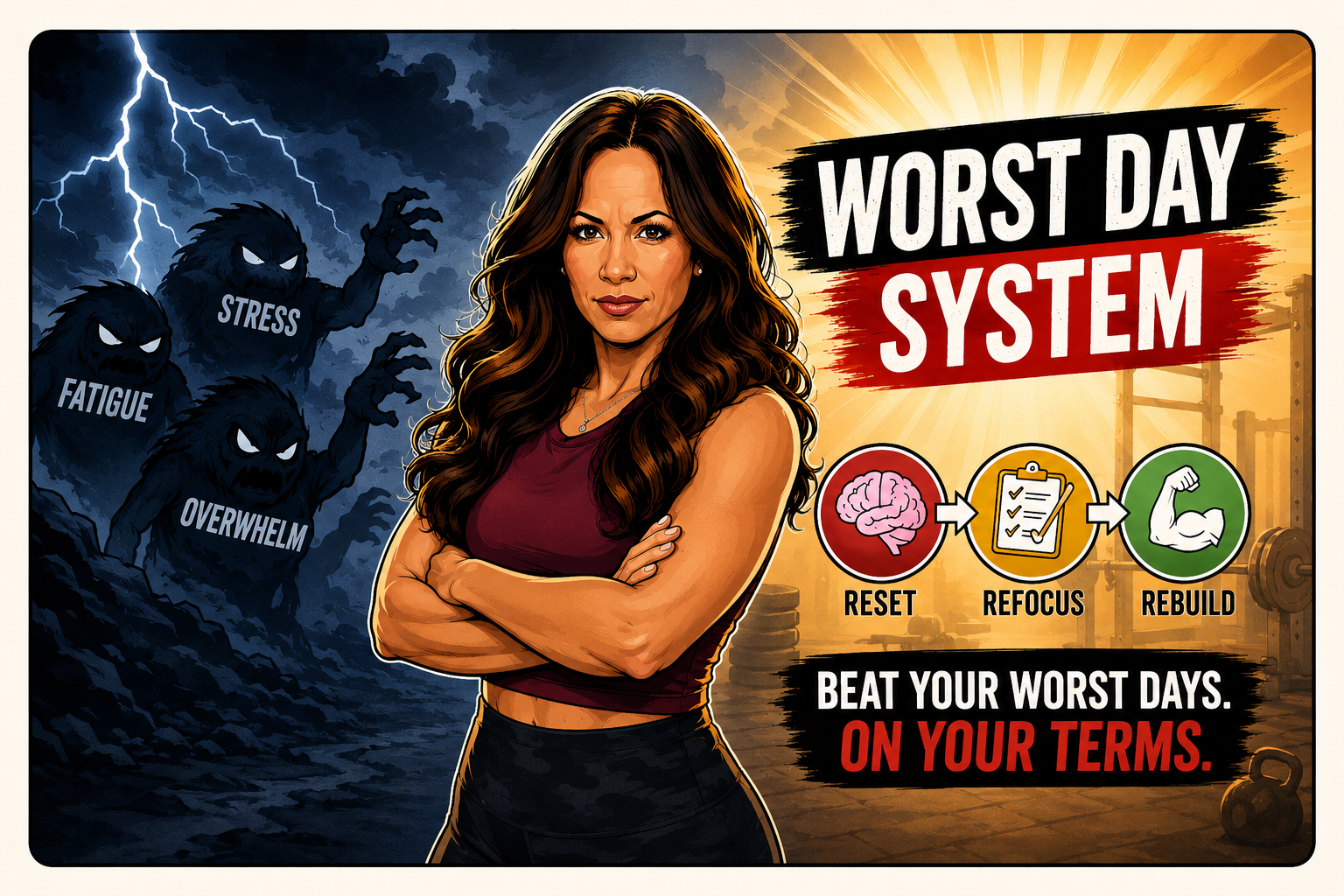
Your Worst Days Are Out to Get You. Here's How to Beat Them at Their Own Game.
Midlife Health | Nutrition, Fitness & Mindset
Why consistency collapses in midlife, and the three-part fix for the days you've got nothing left.
In a development that will shock absolutely no woman over 40, researchers have confirmed what your sofa already knew: the problem with healthy habits was never the habit. It was the bad day.
You know the one. You slept like you were being interviewed for a job you didn't want. Your to-do list has its own to-do list. And somewhere around 3pm, your willpower quietly resigned and left no forwarding address.
For years, the fitness and wellness industry sold midlife women a simple story: if you just wanted it badly enough, you'd stay consistent. Thirty-day challenges. Six-week transformations. Detoxes that promised everything except an actual explanation. The story was tidy. It was also wrong.
"The issue was never whether exercise and good food work. We know they work. The issue is doing them on a Tuesday that's actively trying to ruin you."
A recent article in the British Journal of Sports Medicine put it plainly. The real barrier to exercise as medicine isn't whether it's effective. It's adherence, the unglamorous business of keeping going long after motivation has packed its bags. Researchers call the space between knowing and doing the adherence gap. Most of us call it "every January."
The Plot Twist: It's Biology, Not a Character Flaw
Here's the part that should come with a sigh of relief. When you "lose motivation" in perimenopause and menopause, you are not failing. Your body is simply changing the rules mid-game and forgetting to send the memo.
As oestrogen declines, so do dopamine and serotonin, the brain chemicals that make a task feel worth doing. So the 6am workout that once felt fine now feels like climbing a hill in wet sand. That's not laziness. That's chemistry, and chemistry doesn't respond to a motivational quote in a swirly font.
Add poor sleep, unpredictable energy, and the mental load of careers, ageing parents, and teenagers who communicate exclusively in grunts, and consistency starts to feel impossible. Yet this is precisely the season when movement and good fuel matter most: for bones, muscle, metabolism, mood, and the kind of energy that doesn't require three coffees and a stern word.
The headline finding
Consistency isn't built on your best days. It's protected on your worst ones. The women who thrive in midlife didn't find more willpower. They built a plan small enough to survive a bad day.
Introducing the Worst-Day System
The fix isn't more effort. It's a plan with three parts, each built for the version of you who is tired, busy, and quietly negotiating with a biscuit. Movement, food, and mindset, all running on the same rule:
"Shrink it. Don't skip it."
That's it. That's the whole system. On a bad day you don't quit, and you don't go big. You do the small version. Here's how it works across all three.
Part 1: Worst-Day Movement
Most workout plans are written for your best day, the one where you slept well and own a matching gym set. She exists. She visits maybe twice a month. So instead of one workout, you keep three, matched to your actual energy.
Green day (low but functional): aim for 15 minutes. A short strength circuit or a brisk walk.
Amber day (running on fumes): 5 to 10 minutes. An easy walk, or a few gentle mobility moves.
Red day (empty): 2 minutes. Ten slow squats by the kettle. And yes, a deliberate rest day also counts.
The two-minute version on a terrible day does more for your long-term habit than a perfect session you skipped. Showing up small is the harder skill. Anyone can train when they feel fabulous.
Part 2: The Worst-Day Plate
On a bad day, women don't eat worse. They eat nothing, then eat the entire kitchen at 4pm like a raccoon with a deadline. Skipping meals feels productive. It isn't. Energy is not a coupon. You cannot bank it for later.
The fix is one habit: every plate gets three things. Protein, a smart carbohydrate, and a little fat, roughly a 40% carb, 30% protein, 30% fat balance. Don't measure it. Just glance and check all three are present. The protein and fat slow down how fast the carb hits your bloodstream, so your energy stops doing its favourite rollercoaster impression.
And it does not need to be impressive. Greek yoghurt, berries, a spoon of nut butter. Eggs on toast with avocado. Tinned fish with crackers and tomatoes. Sad-day food still counts as food.
Part 3: The Worst-Day Mindset
Here's the part the other two depend on, and the part most plans ignore entirely. You can have the perfect 2-minute workout and the perfect lazy plate, and still talk yourself out of both before lunch. Mindset is where worst days are actually won or lost.
The trap is a specific one: the all-or-nothing voice. It says if you can't do the full workout, there's no point. If you already ate badly, the day is "ruined," so you may as well write it off. That voice sounds firm and sensible. It is neither. It is the single most reliable way to turn one rough hour into a rough fortnight.
The worst-day mindset is three small mental swaps. None of them require you to feel positive. They just require you to keep going.
The three mindset swaps
Swap "all or nothing" for "something counts." A 2-minute walk is not a failed 30-minute one. It's a completed 2-minute one. The smallest version is a full win, not a consolation prize.
Swap "I ruined it" for "I get the next decision." One off-plan meal doesn't ruin a day any more than one raindrop ruins a holiday. The next choice is always still yours. There is no "may as well."
Swap the inner critic for the inner coach. Talk to yourself the way you'd talk to a tired friend. You wouldn't tell her she's hopeless. You'd tell her to have a snack and a short walk. Take your own advice.
Notice none of these ask you to feel motivated, inspired, or radiant. Motivation is a lovely guest, but a deeply unreliable employee. The worst-day mindset works precisely because it doesn't depend on a mood. It depends on a decision, and decisions are available even on the days when good moods are not.
Why All Three Run on One Rule
The reason your workouts fall apart on a bad day is the same reason your eating does, and the same reason your motivation does. You built all three for your best self. Then your worst day arrived, found no version of the plan that fit, and quietly deleted the whole thing.
The worst-day system fixes that by making the plan smaller, not your good days bigger. Movement shrinks to two minutes. The plate shrinks to three easy parts. And mindset shrinks the problem itself, from "I've ruined everything" down to "what's my next single decision?"
It even compounds in your favour. A short walk lifts your energy, which makes the balanced plate feel easier, which steadies your blood sugar, which quietens the all-or-nothing voice. One small action makes the next one lighter. That's the opposite of the spiral, and it starts with a single shrunk-down step.
"Bad days don't need your best effort. They need your smallest one, done anyway."
This is the genuinely good news buried in the research. You don't need to become a different, more disciplined person. You don't need a 5am routine or a personality transplant. You need a plan honest enough to admit that bad days exist, and small enough to survive them.
The takeaway
Your worst days were never proof that you can't do this. They were proof that the plan was too big. Shrink the plan, keep the three parts, and consistency stops being a heroic act of willpower. It becomes something much more boring, and much more durable: a thing you simply do, even on a Tuesday that's out to get you.
Want the worst-day system built around your real life?
This article gives you the structure. Working together gives you the part structure can't: a plan shaped to your energy, your week, and the hormonal changes happening right now. If you're tired of starting over, book a free discovery call with Be Limitless Nutrition. We'll talk through where you are and what a movement, food, and mindset plan could look like for you, built for your worst days as much as your best ones.
This article is general guidance, not personalized medical or nutrition advice. If you have a medical condition or specific dietary needs, check with your GP or a qualified practitioner first.
The author is a somehwhat opinionated Functional Nutrition and Functional Medicine coach. And although she holds a PhD and is brilliantly cute, this is not medical advice and should not be interpreted as such.