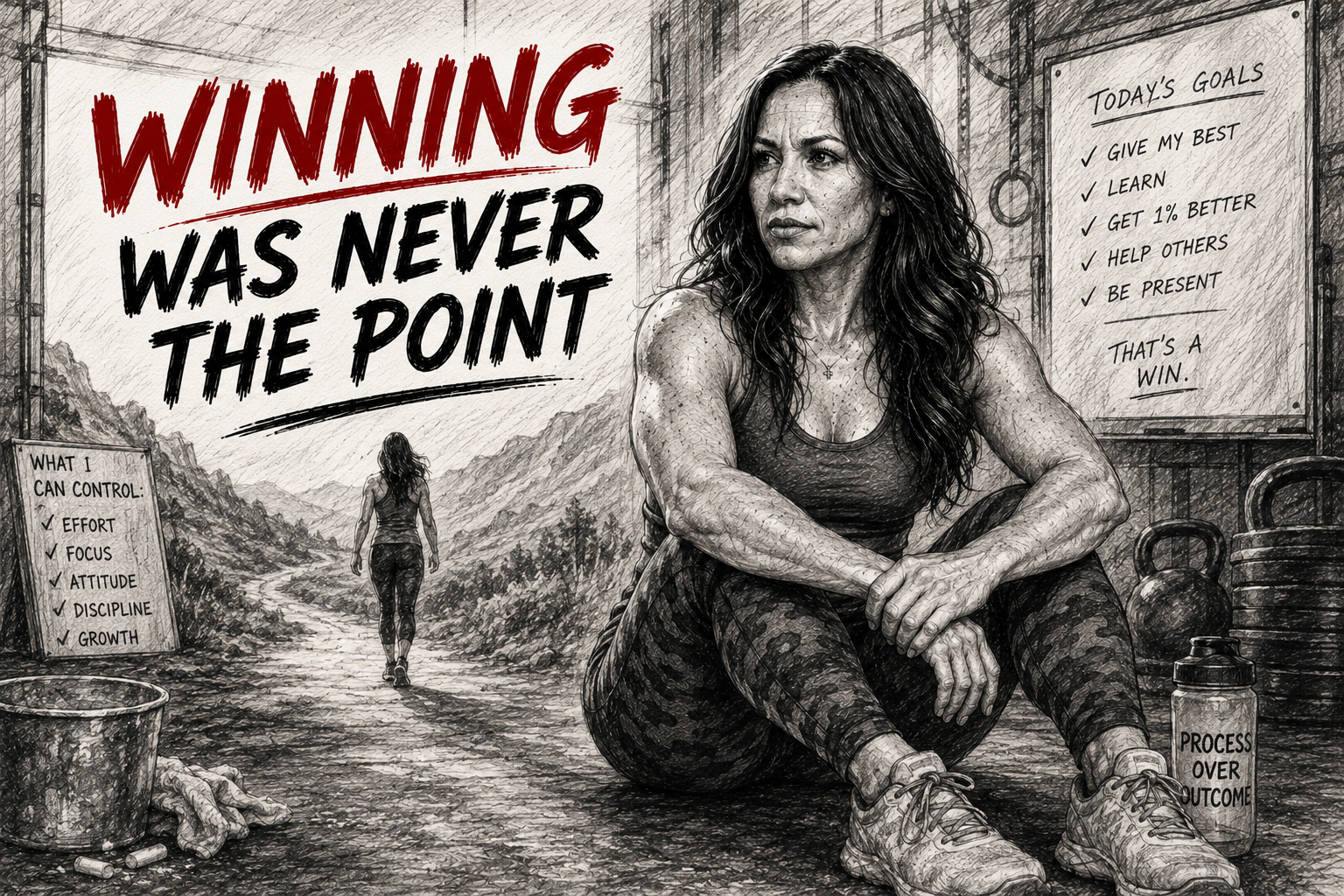
When Winning Was Never the Point
The Failure Lab Series | Mindset
You set the alarm for 4:45 a.m. You hit the protein numbers. You did the accessory work nobody sees. You showed up on the days you felt strong and the days you felt like quitting. You did everything the plan asked of you.
And then you lost.
Maybe you missed the lift by five pounds. Maybe your body changed slower than the woman next to you. Maybe the promotion went to someone else, or the scale stalled, or the competition ended with your name in the middle of the pack. You followed the instructions. You earned the outcome you were promised. The outcome did not show up.
So here is the question almost nobody wants to ask out loud: what if all that work leads nowhere? What if you do everything right and still come up short?
The lie inside the plan
Most training programs sell a quiet promise. Do the work, get the result. Stick to the macros, watch the body change. Put in the reps, take home the medal. The promise feels fair because it sounds like math.
But the math breaks for a lot of people, and it breaks hardest for women over 40. Hormones shift. Recovery slows. Sleep gets unreliable. The same effort that built results at 30 produces a fraction of the visible payoff at 48. You can run the exact program a friend ran and get a different body, a different time, a different verdict.
When the result fails to arrive, most people assume they did something wrong. They add more cardio, cut more food, train through the pain, blame their willpower. They treat the missing outcome as proof of personal failure.
It usually is not. It is proof that outcomes were never fully yours to control.
What you actually control
You control the alarm. You control whether you walk in. You control the rep, the meal, the choice to come back after a bad week. You do not control genetics, judging, timing, luck, age, or the hundred variables that decide who stands on the podium.
This matters because of where you put your sense of worth. Tie it to the result and you hand your self respect to forces you cannot touch. Tie it to the showing up and you keep it.
Diana Nyad tried to swim from Cuba to Florida and failed. She tried again and failed. She failed four times across roughly thirty-five years, battered by jellyfish, currents, and her own body. She finished the swim at 64, on the fifth attempt. The finish gets the headlines. The thing that made the finish possible was the four times she lost and went back to the water anyway.
The lesson is not that you will eventually win if you grind long enough. Sometimes you will not. The lesson is that the woman who kept returning was already someone worth becoming, medal or no medal.
Bigger than the medal
Strip away the trophy and ask what training actually built. Not the body. The person.
You learned to keep a promise to yourself when no one was watching. You learned to feel discomfort and stay in the room. You learned that you could be exhausted, doubtful, sore, and unsure, and still choose to begin again. Those are not consolation prizes. Those are the point.
A medal sits in a drawer. The muscles soften when you stop. The job title changes when the company restructures. The flat stomach is one stressful season away from looking different. Every external prize you can win, you can also lose, and most of them you will.
What does not leave is the proof you built about who you are. The proof that you do not quit when it gets hard. The proof that you do not settle for the easier version of your life because the harder version did not pay out fast enough. That proof shows up in your marriage, your parenting, your career, the way you handle a diagnosis or a layoff or a bad year. It transfers. The medal never did.
The harder definition of winning
Quitting feels reasonable when the results stop. Why keep going if the body will not change, if the podium stays out of reach, if the effort seems wasted? It is a fair question, and the honest answer is uncomfortable.
You keep going because the act of not quitting is the win. Not a stand-in for the win. The actual thing.
Most people will settle. They will decide the work was not worth it because it did not produce the prize they wanted, and they will stop. The few who do not settle become rare, not because they are more talented, but because they redefined the scoreboard. They stopped asking whether they won and started asking whether they showed up. By that measure, they win almost every day.
So train for the result. Chase the lift, the time, the body, the goal. Wanting it is not the problem. Just refuse to let the result decide whether the work mattered.
Because the work already changed you. That happened in the dark mornings, the missed lifts, the weeks you wanted to stop and did not. No judge can take it. No plateau can erase it. No loss can undo it.
You did not waste a single rep. You were building the only thing that was ever fully yours to keep.