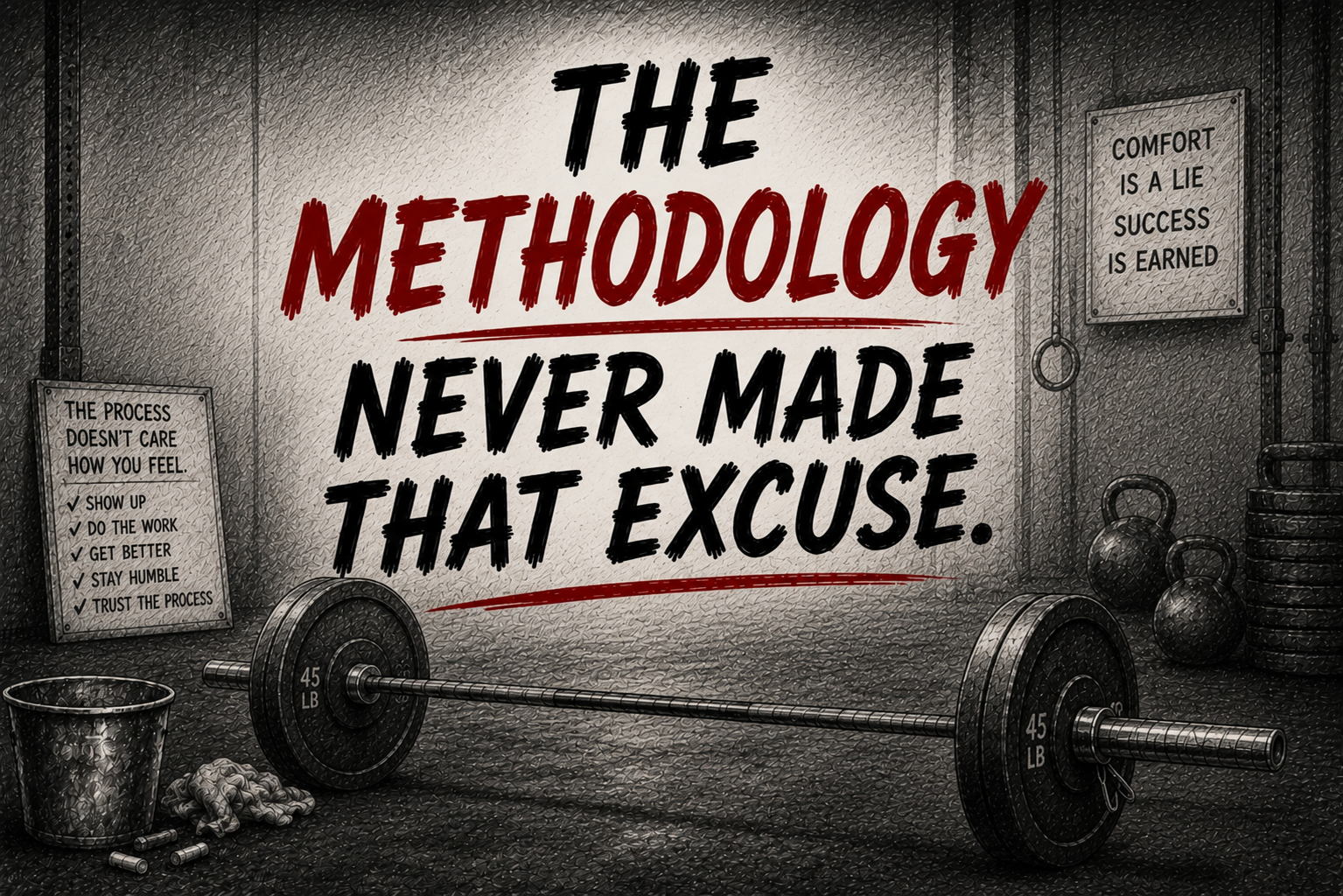
The Methodology Never Made That Excuse
OpEd
The CrossFit Level 1 material lays out a sequence. Mechanics first. Then consistency. Then intensity. You earn each stage before you touch the next one. And it comes with a rule most people can quote and almost nobody enforces: if your mechanics begin to break down, the intensity is too high.
That line is the load management system for the entire method. It tells you exactly when to back off. Your position tells you. Not your ego, not the clock, not the leaderboard. When the depth disappears, when the elbows don’t lock, when the body isn’t stacked, the method has already answered the question. You went too hard.
Now go watch a Semifinal or a Games event.
What we actually see
You see soft knees or shoulders in front of the bar on a heavy deadlift. You see snatches where the hips aren’t in line before dropping the bar. You see squats that stop finding depth once the heart rate climbs. The chest doesn't quite hit the ground on the burpee.Then someone posts the competition clip, and someone else says the same thing every time.
“They have to do that to win. It shows capacity”
I disagree. And I think the people saying it are misusing the exact thing they claim to defend.
The category error
Competition is a test. The methodology is training. Those are two different jobs.
The Open, Quarterfinals, Semifinals, the Games. Those are scored tests of fitness that already exist. Athletes push to their limit because they are being measured against everyone else on the floor. That is the nature of a sport. Fine.
But when you point at a broken rep and say “it’s ok”, you are borrowing authority from a methodology that says the opposite. The methodology never signed off on garbage reps. Its answer to broken mechanics is one sentence, and it is already written. The intensity is too high. There’s no Crossfit definition of “good enough” reps.
You can defend an athlete’s competition decision. You can say they chose to push past their own standard to chase a placement. That is honest. What you cannot do is relabel that choice as ok or validating methodology and hand it back to the rest of us as permission to do the same damn thing in the gym. These athletes are supposed to be the pinnacle, but aren’t representing that to the rest of us.
The part I will concede
At ninety-five to one hundred percent effort, a trained athlete will show some positional change. That is real. A slight shift on a true one-rep max is not the same as a beginner folding in half on a light set. Elite movement under fatigue does not look like a warm-up demo, and it should not have to.
But “some variance at genuine max” and “the standard no longer applies” are two different claims. One is physiology. The other is an excuse. Most of the reps people defend are not once-in-a-season max attempts. They are volume reps in a metcon, and the athlete had the option to slow down and hold position. They chose points instead. Own THAT.
The excuse got weaker, not stronger
Here is the part that ends the argument for me.
The movement at the top of this sport is better than it has ever been. Coaching improved. Athletes specialized. Positions that were normal at the 2008 Games would draw a lot of criticism today. The field moves cleaner, holds position longer, and wastes less energy than any generation before it.
So the “they have to move sub-par to win” line is backwards. The athletes who win are usually the most efficient movers on the floor. Mat Fraser built five straight titles on ruthless efficiency. Tia-Clair Toomey stacked championships on technique that stays clean when everyone else falls apart. Efficiency is what lets them win in the first place.
If clean movement and winning were actually opposed, the podium would be full of the sloppiest athletes in the field. It is not. It is full of the most efficient ones.
Hold the line
Better movement should buy fewer excuses, not more. The athletes today have the coaching, the tools, and the movement quality the early field never had. That raises the standard. It does not lower it.
The methodology set a clear line. Mechanics, then consistency, then intensity, and the moment mechanics break, the intensity is too high. Elite athletes who cross that line are making a competition choice, and they are allowed to. Just call it what it is. A choice. Not the method.
The methodology already told you when to stop. The leaderboard just talked you out of it. Better athletes and cleaner positions should have made that easier to hear, not harder. Virtuosity was the standard the whole time. Answer to that one.
The author is a Functional Nutrition and Functional Medicine coach with strong opinions and a PhD to back most of them. She is also, for the record, extremely cute. None of that gives you a pass on your mechanics.