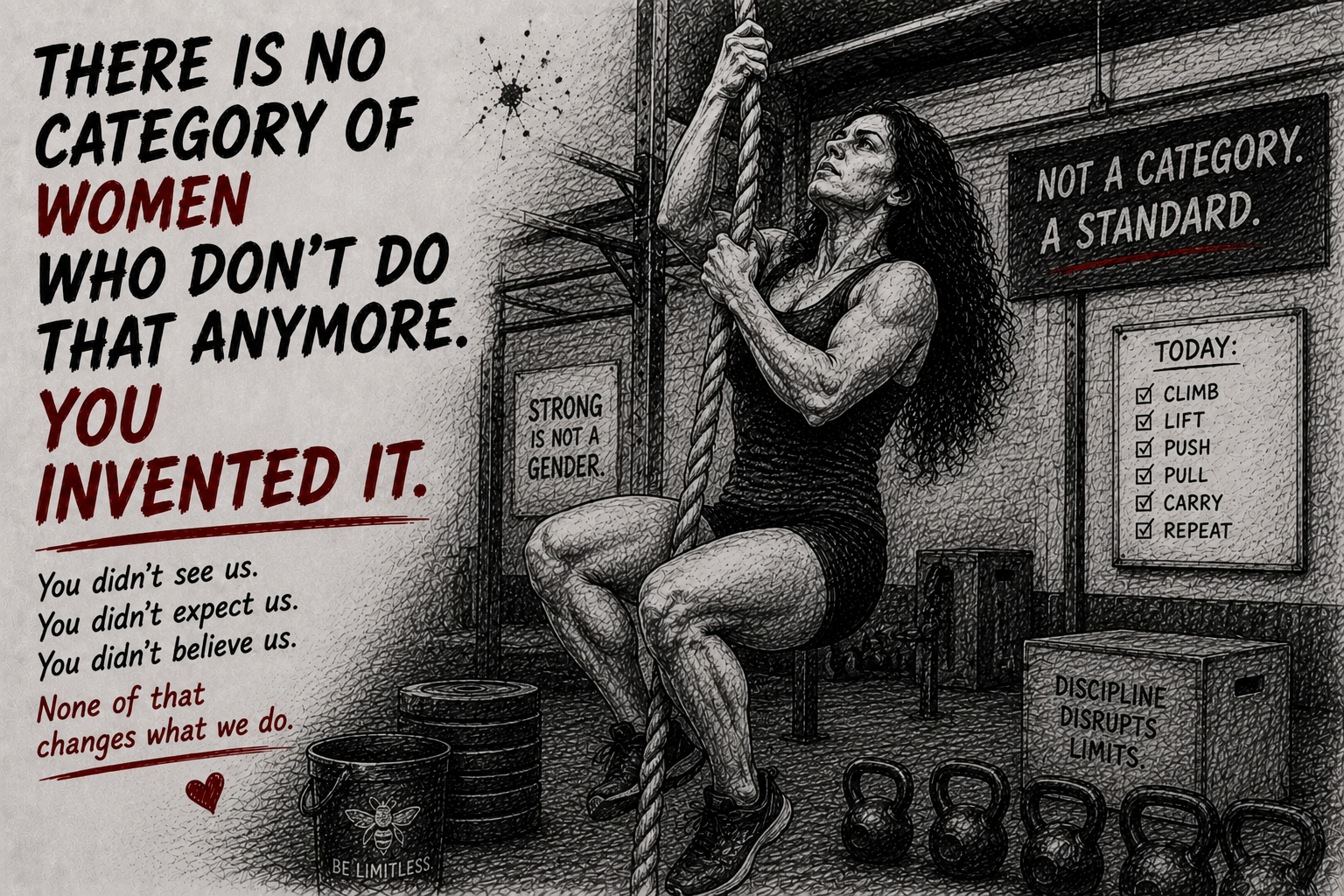
There Is No Category Of Women Who Don't Do That Anymore. You Invented It.
Mindset
I spent years believing I belonged to a group. Women who used to be athletic. Women who do not climb things. Women who watch the class from the side of the room and make a joke about their knees.
Nobody assigned me to that group. There was no letter. I filed my own paperwork, and then I treated it as a permanent record.
You have done this too. Probably several times.
How a category gets built
Listen to how these rules sound when you say them out loud.
I do not lift heavy. I am not a runner. I do not wear that anymore. I am past learning new things. I am not a person who can go to a 5:30 a.m. class. I gave up on my arms in 2018.
Every one of those has the grammar of a fact. Flat, settled, obvious. Trace any of them backward and you find something much smaller: a decision you made once, usually during your worst year, based on one bad experience, and never revisited.
You updated your phone forty times since then. You never updated that.
The physiology does not agree with you
This is the part that irritated me most when I finally went and read the research.
Muscle stays responsive to resistance training deep into your seventies and eighties. Older adults who lift produce measurable gains in strength, muscle mass, and bone density. Postmenopausal women build strength on the same mechanisms as everybody else. The rate of progress slows. The capacity does not vanish.
Go look at masters competition results sometime. There are women in the 65 to 69 bracket deadlifting more than most thirty-year-olds. There are 75-year-olds running marathons. In the video that changed my life, a woman well into her seventies was lifting with more joy than I had felt in a decade, and an athlete with one leg was doing movements I had privately classified as impossible.
I had two working legs and a filing cabinet of reasons. That stopped being comfortable in about four minutes.
The audit
Pick a quiet twenty minutes and write down every sentence that starts with "I don't" or "I'm not" or "I can't anymore." Get ten of them on paper.
Now go through the list and answer three questions for each one.
When did I decide this? Put a year on it. If the year is more than three years back, that rule was written by a woman with different information.
What was the evidence? Usually it is one attempt, one injury, one comment somebody made, or one photo you did not like.
Who benefits from me believing it? Sometimes the honest answer is that you do, because trying is frightening and a rule is easier to carry than a risk.
Most of your list will not survive that process. Cross out what does not hold up.
The 14-day test
Then take one item off the list. One. Something specific and small enough that failing at it does not ruin your week.
Sign up for the class. Book the introductory session. Ask the coach to teach you the movement you have been avoiding. Put it on the calendar with a date, a time, and a location, because a plan without a time attached is a wish.
You are not proving you can do the thing. You are proving the category was made up.
I found this out on a pull-up bar, at 40-something, as the worst athlete in the building. Then I climbed a rope to the ceiling of a gym I had been too intimidated to walk into.
I had decided women like me do not do that. There is no such category.
I bet you have three of them running right now, and I bet you could name them in under a minute.
Dr. Vickie Duncan, PhD, is the founder of Be Limitless, working with professional women 35 and over on nutrition, training, and the stories underneath both.