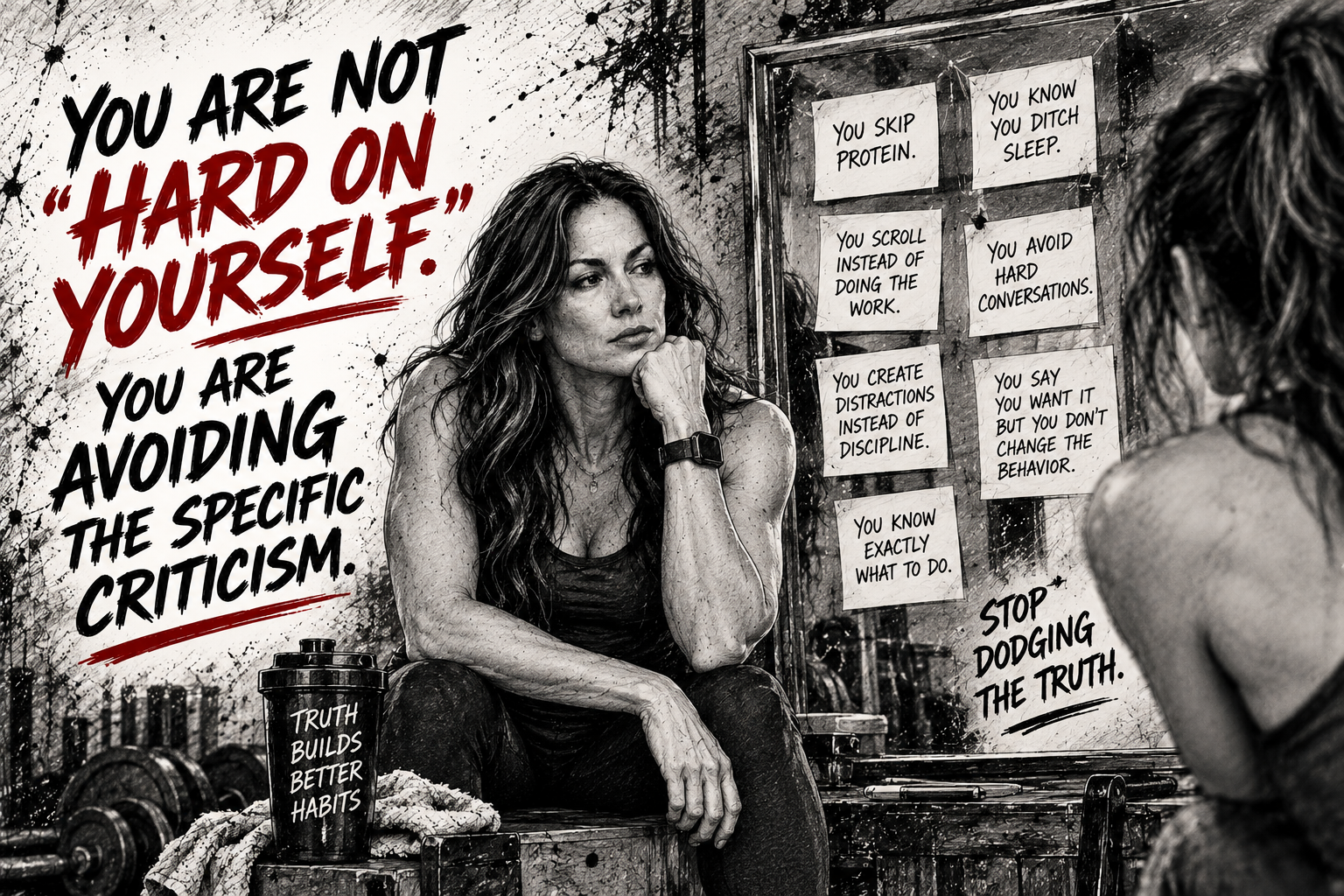
You Are Not "Hard on Yourself." You Are Avoiding the Specific Criticism.
Mindset
"I'm my own worst critic."
People say this the way they'd mention a chronic condition. Half complaint, half credential. It signals high standards. It signals that you don't need anyone else to hold you accountable, because you've got it covered.
Here's the problem. Listen to what the self-critic actually says.
"I'm lazy." "I'm a mess." "I always do this." "I'm so undisciplined." "What is wrong with me."
None of those sentences contains information. You can't act on a single one of them. They describe a person, not a behavior, and people can't be fixed by Friday. So the criticism lands, it hurts, you feel like you've paid a price, and nothing changes. Then you do it again next week and call yourself lazy again.
You've confused accountability with a recurring charge.
The two kinds of criticism
Compare two sentences about the same event.
Sentence A: "I'm so undisciplined."
Sentence B: "I skipped the last three Tuesday sessions, and each time I'd scheduled them after a work call that always runs long."
Sentence A feels worse. It's global, it's about your character, and it's permanent. Sentence B feels neutral, almost clinical. It's about one behavior, one pattern, one cause.
Only one of them tells you what to do. Move the Tuesday session, or kill the meeting, or stop pretending you'll train after it. Done.
Sentence A has no next step. That's the appeal. It costs you a bad feeling and asks nothing else. Sentence B costs you a change.
Why the vague version feels like the honest one
There's a reason "I'm lazy" feels truer than "I skipped three Tuesdays."
Roy Baumeister and colleagues reviewed the research on negative versus positive information in 2001 and found that bad information gets processed more thoroughly, bad self-definitions are avoided more strongly than good ones are sought, and negative impressions form faster and resist correction longer. Your brain treats the global negative verdict as high-priority data. It feels important because your wiring flags it as important.
So the vague criticism arrives with a sense of weight. It feels like you're finally being honest with yourself. What's actually happening is that you're being dramatic with yourself, and drama is a substitute for a plan.
The research on what actually changes behavior
In 2012, Juliana Breines and Serena Chen at Berkeley ran four experiments testing whether self-compassion or self-criticism produced more motivation to improve after a failure.
Participants who were prompted to respond to a mistake with self-compassion, compared to those in a self-esteem condition or a neutral control, were more likely to see their weakness as changeable, reported more motivation to make amends after a moral lapse, and, in the most concrete test, spent more time studying for a hard test after failing a first attempt.
The people who beat themselves up studied less. The people who treated the failure as a specific, fixable event studied more.
That result annoys a lot of people, especially in fitness. It sounds soft. But read the study carefully. Self-compassion in Breines and Chen's design wasn't "you're great, don't worry about it." It was: this happened, it's a normal thing for a person to get wrong, what specifically do you do next. Which is Sentence B.
The hiding place
Here's the accusation at the center of this article.
Global self-criticism is comfortable. It hurts, but it's a familiar hurt, and it comes with a hidden benefit: it excuses you from the specific inventory.
If you're "just undisciplined," you don't have to look at your calendar and notice you've scheduled every workout at your most depleted hour. If you're "bad at relationships," you don't have to notice that you cancelled on the same friend three times in a month. If you're "a mess," you don't have to open the credit card statement.
The global verdict is a way to feel like you've faced the truth without reading a single line of it.
You know this is true because of what happens when someone else gets specific with you. A coach says "your elbows drop on the third rep every time you go above 70 percent." That lands differently than "your form is bad." It's more useful and it's more uncomfortable, because now you have to fix your elbows. "Your form is bad" you can carry around as a mood. "Your elbows drop on rep three" is an instruction.
How to get specific
Every time you catch a global verdict, force it into a report. What did I do or not do. When. How many times. What was going on right before. "I'm lazy" becomes "I've hit the snooze button an average of four times a morning for two weeks, and I've been going to bed after midnight scrolling." "I never follow through" becomes "I've started three programs since January and dropped each one between weeks five and seven." "I'm bad with people" becomes "I interrupted my sister twice at dinner and checked my phone during her story."
Notice two things. First, the specific version is less painful. It's just facts. Second, the specific version is more damning, because there's nowhere for you to hide. You can dispute "lazy." You cannot dispute four snoozes.
The counterargument
Some people will say the harsh internal voice got them where they are. High standards, no excuses, self-flagellation as fuel.
Maybe. But look at what the harsh voice actually said in the moments that produced results. Odds are it was specific. "You didn't warm up. You went too heavy too soon. You quit at rep eight when you had ten." Those are Sentence B in an angry tone. The specificity made it work, not the tone.
You can keep the tone if you like it. Just make it say something.
The test
Next time you hear yourself deliver a verdict, ask whether a stranger reading it could tell you what to change.
If not, you haven't criticized yourself yet. You've just insulted yourself and called it discipline.