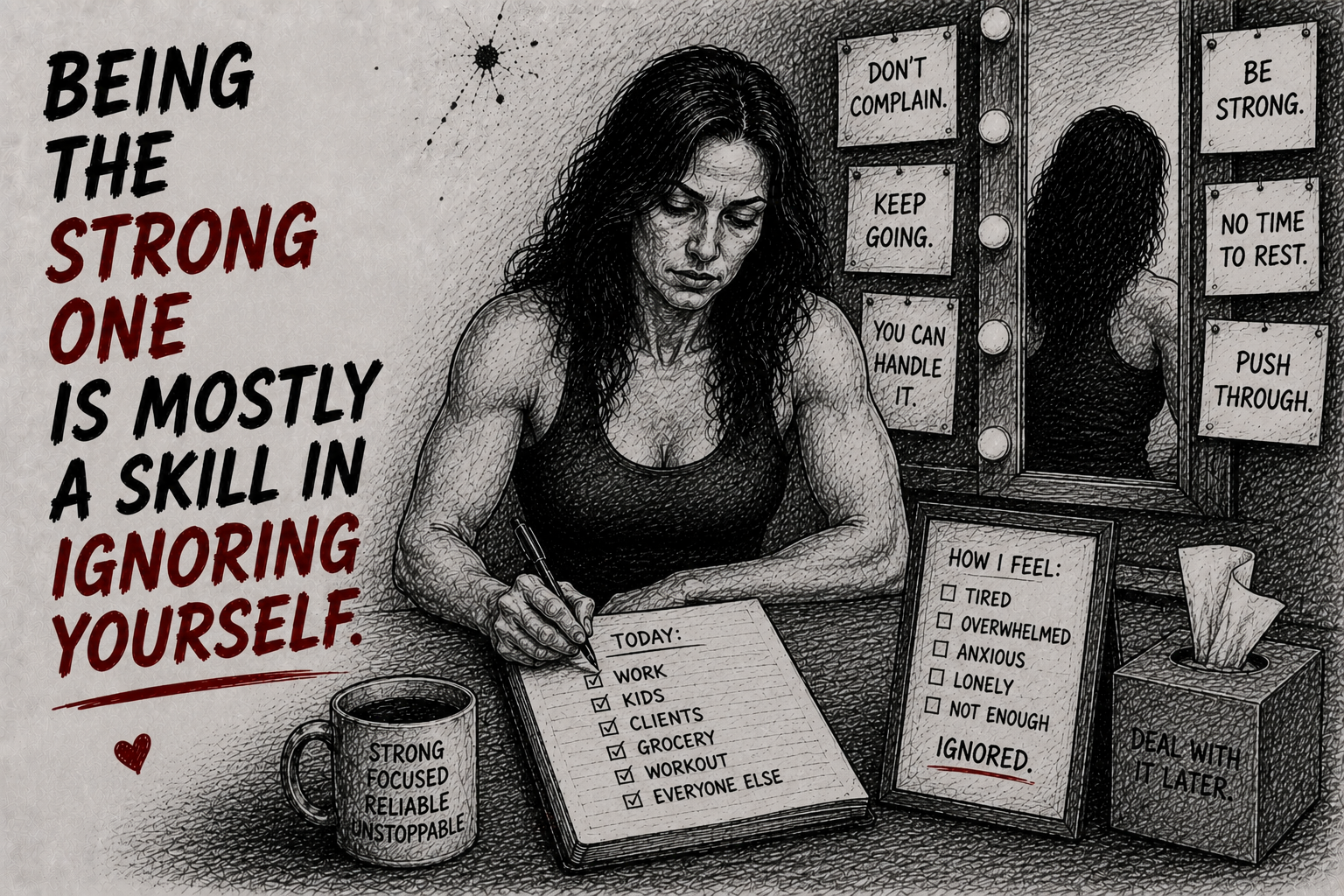
Being The Strong One Is Mostly A Skill In Ignoring Yourself
Mindset
You know your mother's medication list from memory. You know which of your kids needs the dentist and which one needs the orthodontist consult. You know your partner's cholesterol number.
Now tell me the last time you had bloodwork run.
Take your time.
The job description nobody hands you
Being the strong one starts as a genuine strength. Life comes at you early, you learn to handle it, and people notice. You become the person who gets the phone call when things fall apart. You show up. You figure it out.
Then the identity hardens, and it stops being something you do. It becomes what you are, which means every situation now requires it, which means there is no version of a hard week where you get to be the one who needs something.
I lived inside that role for years, and I was proud of it. It made me competent and useful and completely unable to register my own data.
What it actually costs
Here is the mechanism, and it is not subtle.
Your body sends signals. Fatigue that sleep does not fix. A cycle that has changed. Anxiety with no matching event. Weight that moved without your eating changing. Waking at 3 a.m. with your heart going.
A person with normal self-attention treats those as information. The strong one treats them as noise to be pushed through, because the strong one has things to handle. You get very good at overriding the signal, and the skill compounds. Six months becomes three years. Three years becomes a decade of "I will deal with it after this quarter."
I had bone-deep exhaustion, unexplained weight gain, mood swings, and brain fog thick enough to lose sentences in. I managed all of it around a full workload for years before I insisted on real answers. When I finally did go, I heard my labs were normal and accepted that, because the strong one also does not make a fuss.
Three moves that actually work
Write your symptoms as if they were somebody else's. Take a notebook, describe the last six months in third person, and read it back. "She has been exhausted for two years, has gained twenty pounds, wakes at 3 a.m., and cries at commercials." You would have that woman at a clinic by Thursday. Give yourself the same appointment you would fight to get for her.
Do a delegation test and lose on purpose. Pick one thing this week that you always handle. Hand it off. Then let it be done at 70% and do not fix it afterward. If the whole thing collapses because you took your hands off it for four days, you have found a structural problem, not a character flaw.
Book two hours a week and defend them like client work. Put them on the calendar with a name. Training, meal prep, a walk, an appointment. Two hours out of 168. Nobody in your life will find those hours for you and hand them over as a gift.
The reframe I needed
For a long time I read taking care of myself as a withdrawal from everyone else. Time and energy pulled out of the account that funds my family, my work, my clients.
That framing is wrong, and the arithmetic proves it. I was running at roughly 60% capacity for years and calling it dedication. The version of me who trains, eats enough, sleeps, and has actual answers about her own hormones gets more done in a week than the exhausted version got done in a month.
Strength that only points outward is not strength. It is a slow leak with excellent public relations.
Handle yourself with the same competence you hand everyone else. You are extremely good at this job. Try doing it for your own file.
Dr. Vickie Duncan, PhD, is the founder of Be Limitless, a functional nutrition and functional medicine practice for professional women navigating perimenopause and menopause.