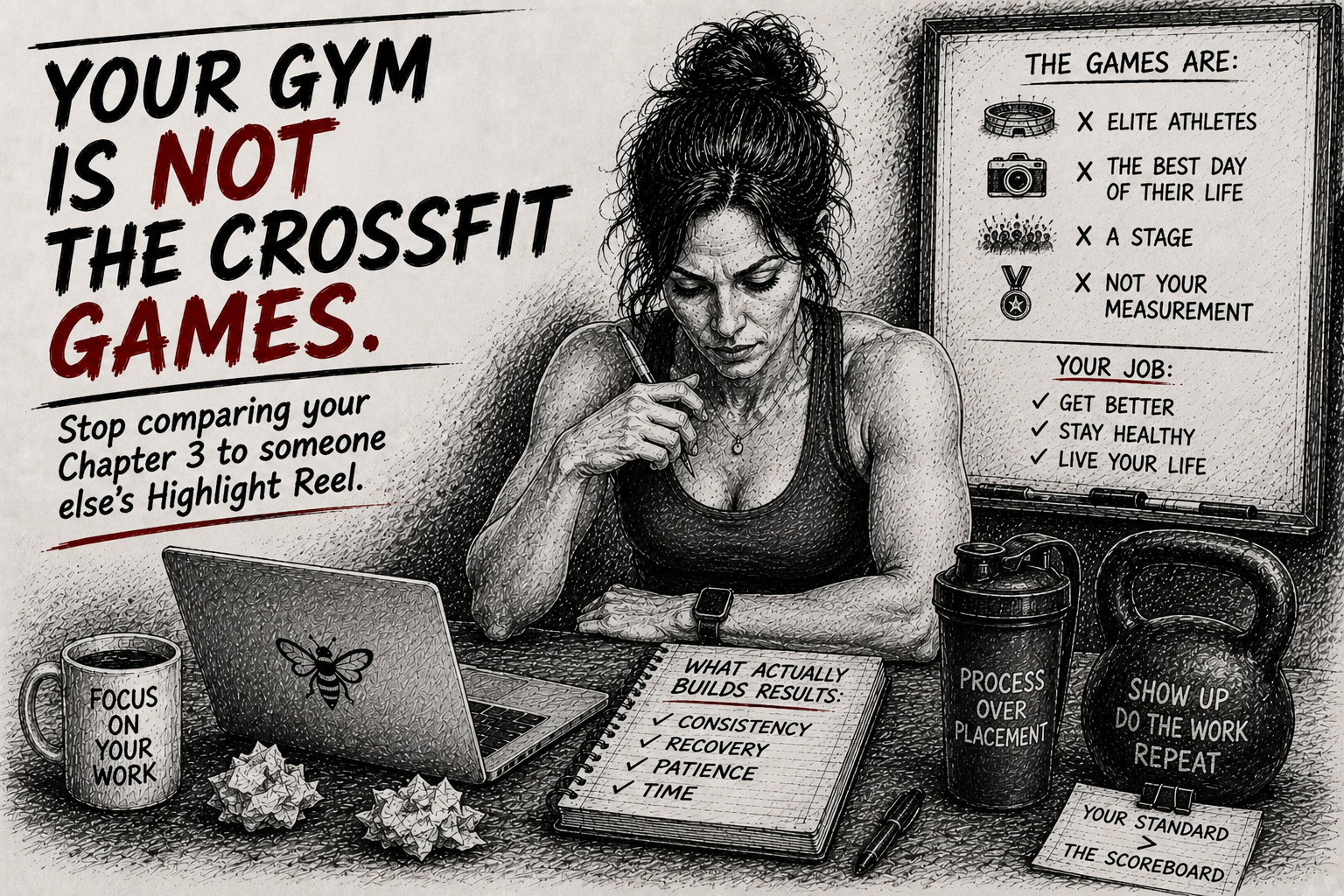
Your Gym Is Not The CrossFit Games
The Failure Lab Series | Mindset
James Sprague trains for a living. You have 50 minutes and a job.
Training like him is not ambition, and the injury data is fairly clear about what it is instead.
James Sprague won the 2026 CrossFit Games in San Jose. He is 24. Aimee Cringle won the women's title. She is 26. The individual winners were set to take home roughly $200K each.
That last number is the important one, and almost nobody trains like they understand it.
Sprague and Cringle are not enthusiasts who got very good. They are professionals. Fitness is the job, the income, and the schedule. CrossFit's own Competitor's Training Guide says that at the Games-athlete level, the majority of the day goes to training, and it is not uncommon to spend three to six hours a day in the gym.
You have 50 minutes at 5:30 a.m. before work, with a coach who has eleven other people in the room.
You are watching a professional and copying the output.
The reference standard moved and nobody announced it
Around 254,000 athletes registered for the 2026 Open, up about 8.1 percent from 2025. Most of them will never compete at anything. They come to a class, they do the workout, they leave, they go to work.
But the picture in their heads comes from the broadcast. The clips are of 24-year-olds who ran 7,200 meters at the Ranch and then did it again the next day. The programming they see online is written for people whose recovery is a full-time occupation.
Twenty years ago, the reference point for a recreational athlete was the fittest person at their own gym. Now it is the fittest person on Earth, delivered in 40-second clips, every day, at no cost.
That comparison does not raise your standard. It raises your risk.
What the injury numbers actually say
CrossFit is not unusually dangerous. That claim gets thrown around and the research does not support it. A meta-analysis in the German Journal of Sports Medicine put the pooled injury rate at 3.20 per 1,000 training hours, which sits in the same range as weightlifting and below several popular sports. Systematic reviews consistently land near the same figure. Most of these injuries are mild to moderate.
The interesting part is who gets hurt.
Athletes with under six months of experience were injured at 3.90 per 1,000 hours. Athletes past five years were at 0.25. That is a fifteen-fold difference in the same sport, in the same gyms, doing the same movements.
A review in the International Journal of Sports Medicine found that switching between prescribed and scaled loads was associated with substantially higher injury risk, with an odds ratio of 3.5. Time in the sport was protective, at roughly 0.7 per added year.
Competing has shown up repeatedly as a risk factor. So has training more hours per week. So has the absence of coach supervision.
Read those together and the profile is not hard to assemble. The person most likely to get hurt is new, doing high volume, going Rx on days that call for scaling, and treating a Tuesday class like a Games event.
The shoulder takes about a quarter of it. The spine takes about the same. The knee follows.
Scaling is not a lower division
The single most useful behavior in the data is also the one people find humiliating, which tells you something about the culture rather than the sport.
Going up in load because the whiteboard says Rx, when your last three sessions said otherwise, tripled injury odds in that review. That is a decision made for the room, not for the body.
Nobody at the Games is doing this. Elite athletes scale constantly. They deload, they sit out movements, they modify around a cranky elbow for six weeks, and they do it under a coach who is being paid to make sure they arrive in July intact. The professionals are more conservative with their bodies than the accountant in the 6 a.m. class, because the professionals have something to protect.
You have something to protect too. It is the next twenty years.
Train for the age you will be
CrossFit's age-group divisions run from 14-17 up to 70 and over. The masters field is deep enough that the top 400 athletes in the 35 to 54 divisions advance out of Quarterfinals.
Those athletes are worth watching precisely because their situation resembles yours. Many hold jobs. Most have families. Their programming accounts for tendons that take longer to recover and a schedule that does not clear itself.
They also did not get there by hammering themselves at 32. They got there by still being able to train at 47, which required not blowing out a shoulder fifteen years earlier trying to match a workout written for someone paid to do it.
Here is the boring version of a good plan. Three to five sessions a week. Loads you can move well on your worst day, not your best. Scaling written down in advance so the decision is not made under peer pressure. A coach who watches you. Enough sleep to justify the intensity you are asking for.
That plan will not produce a highlight clip. It produces a 47-year-old who can still deadlift, which is the actual prize.
The part the critics get wrong
None of this is an argument for training soft, and the people who use injury statistics to dismiss the whole sport are being dishonest with the same numbers. The rate is comparable to other barbell sports. The five-year figure of 0.25 per 1,000 hours suggests that experience and coaching solve most of the problem. Intensity is the reason the method works, and stripping it out leaves you with a worse gym.
The argument is narrower than that. Copy the intensity. Do not copy the volume, the load, or the calendar of a 24-year-old professional with a physio on retainer.
Sprague will be back next August. He will be 25 and it will still be his job.
You will be at the 5:30 class with a job of your own. Go hard. Scale honestly. Nobody is filming.
This article was written by Dr. Vickie Duncan, PhD. She’s a recovering “comparison junkie” who gets the difficulty of breaking out of that trap.