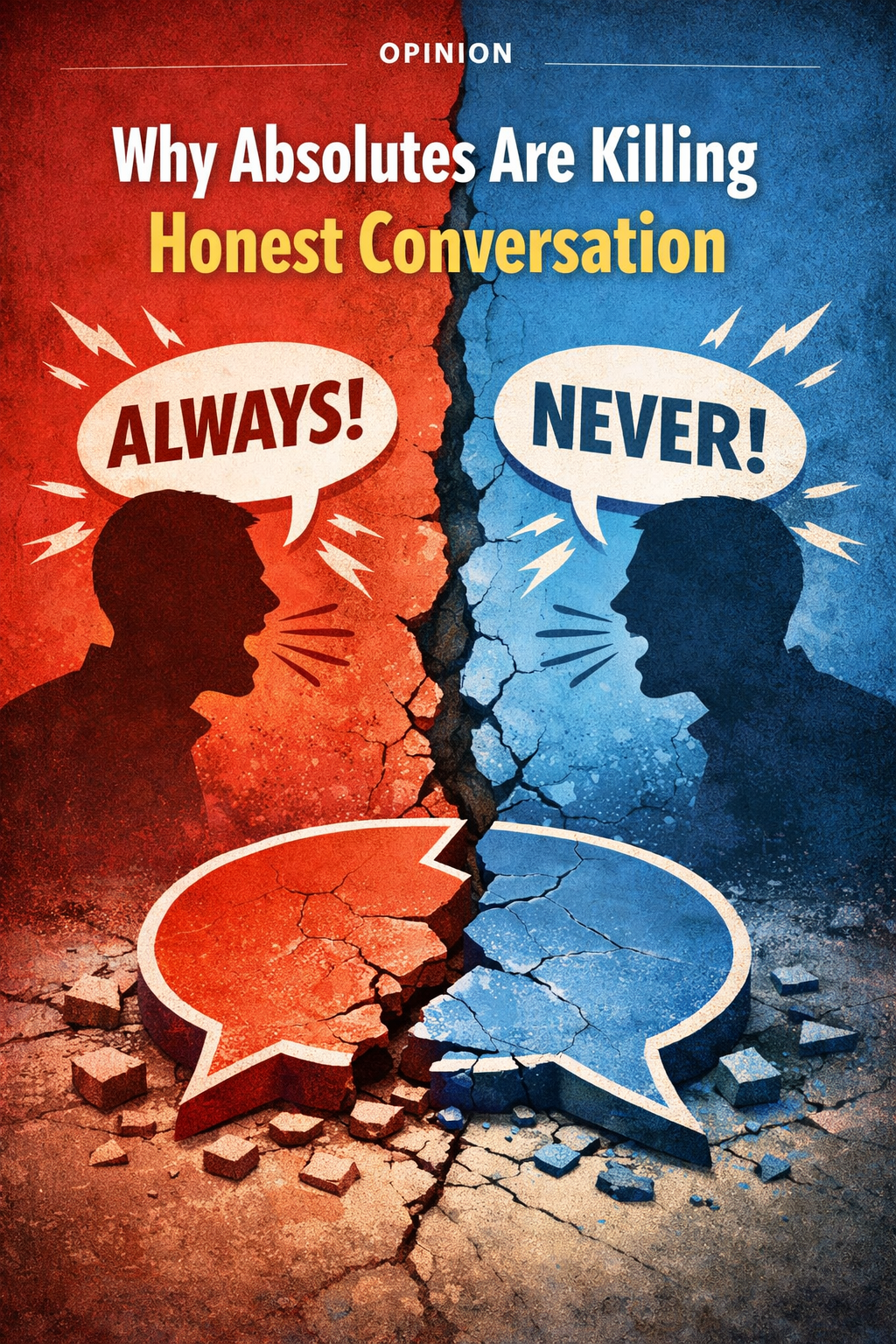
Why Absolutes Are Killing Honest Conversation
OPINION
The Tyranny of “Always” and “Never”
There’s a rhetorical trick so common we barely notice it anymore. It slips into podcasts, press conferences, social media threads, and dinner table arguments with the quiet confidence of someone who has never once been wrong. It sounds like this:
“He’s always only cared about the CrossFit Games.”
That was the claim Brian Friend made on a recent episode of the Andrew Hiller podcast—a sweeping, tidy summary of another person’s entire inner life, delivered as though it were settled fact. No qualifiers. No room for nuance. Just a clean, absolute declaration about what someone has always felt, believed, or wanted.
And nobody blinked.
We shouldn’t let that slide. Not because Friend is uniquely guilty—he isn’t—but because this kind of language has become the default setting of modern discourse, and it’s making all of us dumber.
The Seduction of “Always” and “Never”
Absolutes are intoxicating. They’re efficient. They feel authoritative. When you say someone “always” does something or “never” cared about something else, you’re offering your audience a finished product—a conclusion with no assembly required. There’s no ambiguity to sit with, no complexity to untangle. The listener gets to nod along, and the speaker gets to sound like the smartest person in the room.
But efficiency and accuracy are not the same thing. In fact, they’re often at war with each other.
Think about the architecture of a statement like “He’s always only cared about the CrossFit Games.” That sentence contains two absolutes stacked on top of each other—always and only. It asserts that across every moment of a person’s career, through every decision and every relationship, there has been one singular, unwavering motivation. No evolution. No competing priorities. No human messiness whatsoever.
That’s not analysis. That’s a cartoon.
A Culture Addicted to Certainty
This isn’t a problem confined to fitness podcasts. It’s everywhere. Political commentators tell us a politician “has never cared about working people.” Sports analysts declare that a coach “only ever plays favorites.” Online critics announce that a company “has always been about greed.”
These statements share a common DNA: they flatten years of decisions, contradictions, and context into a bumper sticker. They trade the hard work of understanding for the cheap thrill of verdict.
And social media has accelerated the trend. Platforms reward brevity, confidence, and heat. A measured take—“He seems to have prioritized the Games over other aspects of the sport in recent years, though it’s hard to know his full reasoning”—doesn’t generate clicks, comments, or retweets. But slap an “always” or “never” on it, and suddenly you’ve got content.
The result is a public conversation that increasingly sounds like a courtroom where every witness has perfect memory, every motive is transparent, and nobody has ever changed their mind.
Why It Matters More Than You Think
Some will argue this is a minor linguistic complaint—a grammar nerd’s pet peeve dressed up as cultural criticism. But language shapes thought, and absolute language shapes absolute thinking.
When we speak in absolutes, we stop asking questions. If someone has always only cared about one thing, then there’s nothing left to learn about them. The case is closed. Curiosity—the very engine of good journalism, good commentary, and good conversation—gets shut off at the switch.
It also poisons the well of good-faith disagreement. Absolutes are inherently accusatory. They don’t describe a pattern; they assign a permanent character trait. And once you’ve defined someone in permanent terms, there’s no path to dialogue—only to defense or attack.
Consider the difference:
“He’s always only cared about the Games” — a verdict.
“It seems like the Games have been his top priority, sometimes at the expense of other things” — an observation that invites discussion.
The first closes the door. The second opens it. We need more open doors.
The Irony Nobody Talks About
Here’s the part that should give every podcast host, columnist, and social media commentator pause: absolute statements are almost always wrong. Not sometimes. Not occasionally. Almost always.
Human beings are contradictory, inconsistent, and stubbornly complex. A person who prioritizes one thing today may have agonized over that choice yesterday. A leader who appears single-minded in public may wrestle with competing loyalties in private. We know this about ourselves—we just refuse to extend the same grace to others.
And the people most prone to speaking in absolutes are often the ones with the least access to the full picture. Commentators and analysts, by definition, are on the outside looking in. They see press conferences, public decisions, and results. They don’t see the private conversations, the doubts, the trade-offs, or the sleepless nights. Certainty, in that position, isn’t confidence. It’s overreach.
A Modest Proposal
This isn’t a call to eliminate strong opinions. The world doesn’t need more mealy-mouthed hedging or cowardly both-sides-ism. Say what you think. Take a stand. Be bold.
But be honest about what you actually know.
Replace “always” with “often.” Swap “never” for “rarely.” Trade “only” for “primarily.” These aren’t weaker words—they’re more accurate ones. And accuracy, in a media landscape drowning in hot takes and tribal certainty, is a radical act.
The next time you hear someone—a podcaster, a pundit, a friend at a bar—declare that a person has “always” been this or “never” done that, ask yourself a simple question: How could they possibly know that?
The answer, almost every time, is that they can’t. They’ve just decided that sounding sure is more important than being right.
And that’s a trade-off we should all stop making.
The views expressed in this article are solely those of the author and do not necessarily reflect the views of any affiliated organization.