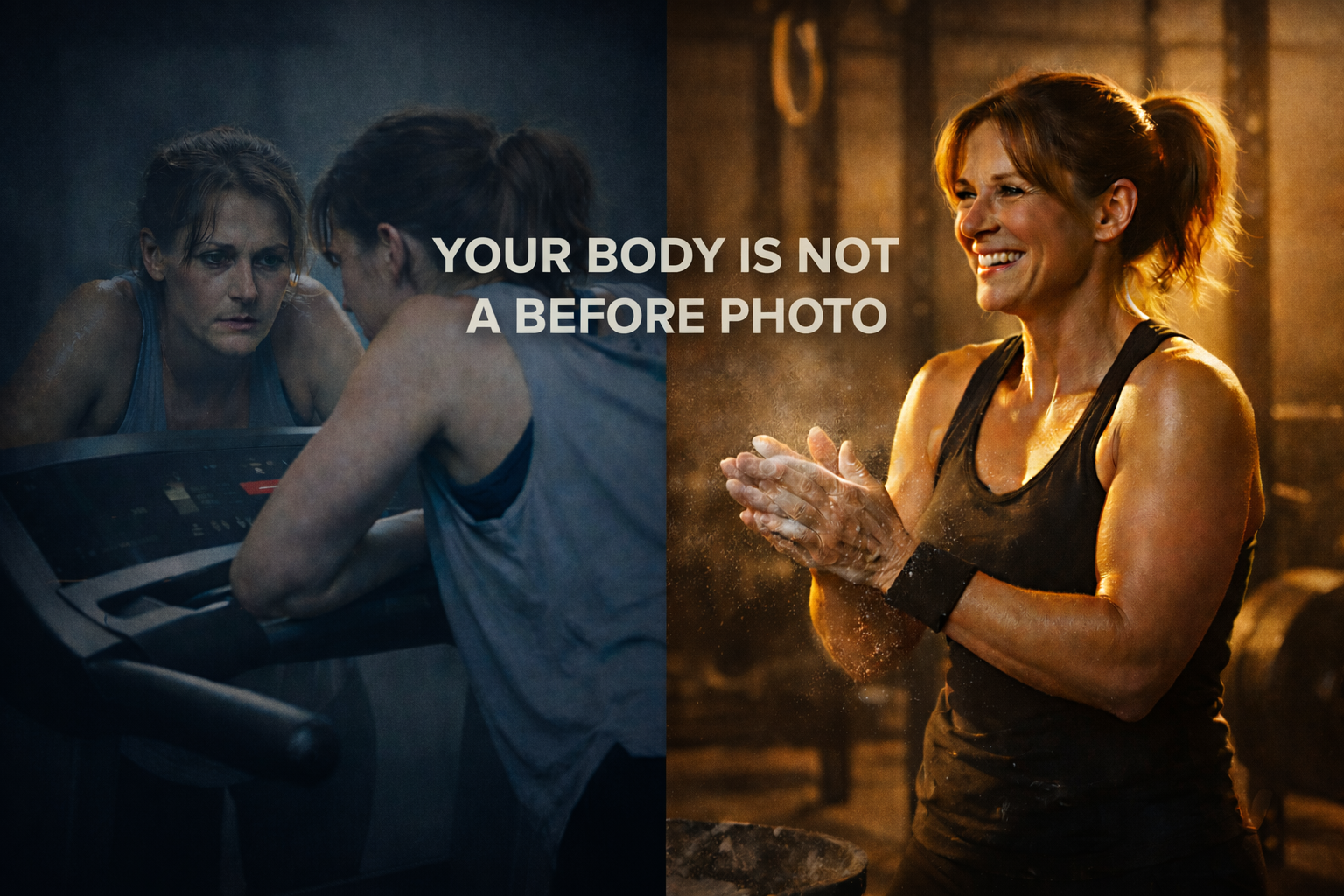
Your Body Is Not a Before Photo
OPINION
Why the Fitness Industry's Obsession with Aesthetics Is Failing Us
We've all been there. You're scrolling through your feed at 6 a.m., coffee in hand, maybe feeling pretty good about yourself — and then it hits. A perfectly lit, perfectly angled, perfectly edited physique staring back at you with a caption that reads something like, "No excuses. Rise and grind." Suddenly, the body you woke up comfortable in doesn't feel like enough.
The fitness influencer economy is a multibillion-dollar machine, and its primary currency isn't dumbbells or discipline. It's insecurity. And it's time we talked about what it's actually doing to us.
I know, because I spent the better part of two decades buying what it was selling.
My Decades-Long Chase for "Skinny"
For most of my adult life, I didn't want to be strong. I didn't want to be fast, capable, or resilient. I wanted to be thin. That was the goal — the only goal — and everything I did in the name of "health" was in service to the number on the scale or the size on the tag.
I counted every calorie. I spent hours on ellipticals going nowhere, literally and figuratively. I skipped meals before events so my clothes would sit a certain way. I celebrated when I was smaller and punished myself when I wasn't. I called this discipline. I called it dedication. What it actually was, looking back, was a quiet, exhausting war against my own body.
And the worst part? It worked — sometimes. I'd hit the number. I'd fit into the jeans. And I'd feel good for about forty-eight hours before the anxiety crept back in, because maintaining "skinny" through restriction and over-cardio is a full-time job with no PTO and no retirement plan. The finish line kept moving because there was never a finish line. There was only thinner.
It took me until my late forties to understand that I had been chasing the wrong thing for decades. That realization didn't come as a lightning bolt. It came slowly, painfully, through a body that had finally started pushing back — injuries that wouldn't heal, fatigue that wouldn't lift, and a growing awareness that I could fit into my smallest clothes and still not be able to carry my own luggage through an airport without losing my breath.
I wasn't fit. I was just small. And those are not the same thing.
The Mirror Trap
My story isn't unique. It's the predictable result of a culture that treats the body as a visual product. The transformation photos, the shredded selfies, the "what I eat in a day" posts — they train us to evaluate our bodies the same way we'd evaluate a product listing. Does it look right? Is it lean enough? Are the proportions acceptable?
This framing has consequences. Research consistently links social media fitness content to increased body dissatisfaction, disordered eating behaviors, and compulsive exercise — not just among teenagers, but across every age group. When we reduce the human body to a visual product, we lose sight of something essential: the body is not an ornament. It's an instrument.
And the performance gap between what influencers show and what they actually do is staggering. Favorable lighting, strategic dehydration, pump-timing, and photo editing are standard practice. The "result" you're comparing yourself to often doesn't even exist in real life. You're measuring your flesh-and-blood body against a digital fiction — and I measured mine against it for years.
What CrossFit Got Right
Say what you will about CrossFit — and people certainly do — but the culture got one thing profoundly right: it shifted the conversation from what the body looks like to what the body can do.
Walk into a CrossFit gym and the whiteboard doesn't track waist measurements. It tracks pull-up PRs, deadlift maxes, and mile times. The woman next to you isn't celebrated because she has visible abs. She's celebrated because she just cleaned 185 pounds for the first time in her life. The sixty-year-old man in the corner isn't invisible. He's revered because he showed up, scaled the workout intelligently, and moved better today than he did last month.
This is the mentality that finally broke through for me. When I stopped asking "will this make me smaller?" and started asking "will this make me stronger?" — everything changed. Not overnight. Not without grief for the years I'd lost to the wrong pursuit. But fundamentally, irreversibly.
I picked up a barbell for the first time in my late forties, and within months I was doing things I couldn't have done at twenty-five — not because I was younger or thinner then, but because I'd never once tried to be capable. I'd only ever tried to be less. Less weight. Less space. Less of myself.
When your metric is performance — when you care about whether you can carry your groceries without pain, keep up with your kids or grandkids, hike without stopping, or pick yourself up off the floor independently at age eighty — the entire emotional relationship with your body changes. You stop punishing it for how it looks and start partnering with it for what it can accomplish. Gratitude replaces shame. Progress replaces perfection.
And here's the irony no one talks about: when I stopped training to be thin, my body changed in ways that all those years of restriction never achieved. Not because I found some magic protocol — but because I was finally training consistently, eating to fuel performance instead of starving to maintain a size, sleeping to recover, and actually enjoying the process enough to sustain it for years instead of weeks.
The Influencer Problem Isn't Going Away — But Your Response to It Can
I'm not naive enough to think the fitness influencer industry is going to develop a conscience overnight. There's too much money in making people feel inadequate. But I do think individuals can opt out of the damage by making deliberate, practical changes to how they consume fitness content and how they define their own progress.
I wish someone had told me this at twenty-five. I wish I hadn't needed two decades and a breaking body to figure it out. But I'm telling you now, and maybe that saves you a few years of fighting the wrong fight.
The solution isn't to abandon social media or stop caring about health. It's to recalibrate what health actually means to you, on your terms, measured by metrics that matter.
Three Things You Can Do Starting Today
1. Audit your feed — ruthlessly. Spend ten minutes right now scrolling through the fitness accounts you follow. For each one, ask a single question: does this account make me want to move my body, or does it make me want to change my body? There's a critical difference. Unfollow, mute, or replace any account that consistently leaves you feeling worse about yourself. Seek out creators who post training logs, movement tutorials, and honest conversations about setbacks. Your feed is your environment — curate it like your wellbeing depends on it, because it does.
2. Set one performance goal that has nothing to do with a mirror. Pick something concrete and skill-based: hold a two-minute plank, run a mile without stopping, do your first unassisted pull-up, touch your toes, carry your suitcase through the airport without switching arms. Write it down. Train for it. When you achieve it, set another one. This is the single change that rewired my entire relationship with exercise — from punishment for how I looked to investment in what I could do. The body you build in the process will take care of itself.
3. Talk about your body differently — out loud. Language shapes perception. The next time you catch yourself saying "I hate my arms" or "I need to lose my gut," pause and reframe. Try: "My legs got me through that hike." Or: "My back is stronger than it was three months ago." I spent years narrating my own body in the language of failure and deficit. Changing that script didn't happen naturally — I had to force it, awkwardly, until it became real. If you have kids, this practice becomes even more urgent — they're learning how to talk about their own bodies by listening to how you talk about yours.
The Bottom Line
The fitness industry will keep selling you the idea that your body is a problem to be solved. It's more profitable that way. But you don't have to buy it. I bought it for the better part of my life, and all it cost me was decades of joyless movement and a relationship with my own body built on contempt instead of respect.
Your body carried you through every hard day you've ever survived. It adapted, recovered, and showed up again. It deserves to be trained with respect, fueled with intention, and measured by what it can do — not by how closely it resembles a stranger's highlight reel.
Move because it feels good. Get strong because it's useful. And if you're reading this in your twenties or thirties, please hear what I wish someone had said to me: stop chasing skinny. Chase capable. Chase durable. Chase the kind of fit that still serves you in thirty years.
The mirror will never tell you what you're worth. But a loaded barbell, a hard trail, and a body that answers when you ask something of it? That will tell you everything.