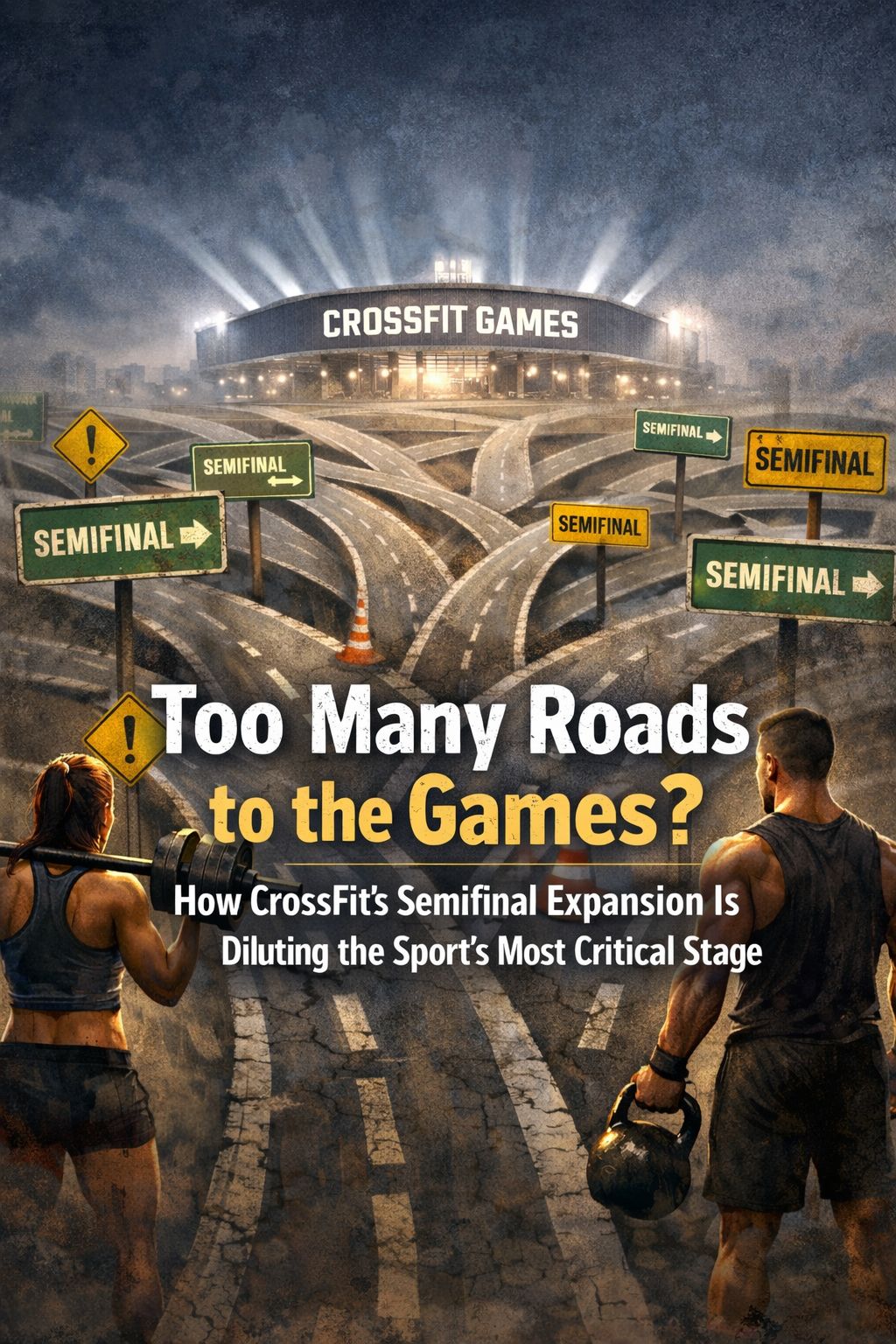
Too Many Roads To The CrossFit Games?
OPINION
How CrossFit’s Semifinal Expansion Is Diluting the Sport’s Most Critical Stage
An opinion on the evolution of CrossFit’s qualification system — and what it costs when everyone gets a second (and third, and fourth) chance.
There was a time when qualifying for the CrossFit Games felt ruthless, binary, and beautifully simple. You did the Open. You survived Regionals. You either earned your spot on the competition floor in Carson or Madison, or you didn’t. The path was narrow, the pressure was immense, and the athletes who emerged on the other side carried a weight of legitimacy that was impossible to question.
That era is long gone. And looking at the 2026 season structure — with its 10 in-person Semifinals, an online Last Chance Qualifier, and Quarterfinals reinstated after a one-year hiatus — it’s fair to ask whether CrossFit has stretched the meaning of “Semifinals” so thin that the word barely holds together anymore.
The Expansion Nobody Asked For (But CrossFit Needed)
Let’s be clear about what’s happened. The 2026 season features events spanning nine consecutive weekends from April through mid-June, spread across locations from Cookeville, Tennessee, to Busan, South Korea, to Paris, France. Each event offers between one and three qualifying spots per gender. After all the in-person dust settles, seven more men and seven more women can still punch their ticket through the Online Semifinals — a format that essentially functions as a last-chance qualifier.
On the surface, the math still seems exclusive: only 30 men and 30 women ultimately make the Games. But the pathway to those 30 spots has splintered into so many routes that the word “Semifinals” has become less of a stage and more of a brand label slapped onto a loose confederation of independently operated competitions.
Compare this to the Regionals era. From 2011 through 2018, the system was elegant in its severity. Athletes competed in their geographic region, performed the same workouts, and only the top finishers — typically five men and five women per region — advanced to the Games. There was no shopping for favorable fields. No choosing a weekend that fit your training cycle. No online fallback. You showed up at your Regional, performed under pressure against the best athletes in your corner of the world, and the leaderboard told the truth.
When “More Opportunities” Becomes “Less Meaning”
The charitable read on CrossFit’s current approach is that it globalizes the sport, supports third-party event organizers, creates more live spectator experiences, and gives deserving athletes multiple bites at the apple. All of those things are true. The Sanctionals experiment in 2019 proved there was an appetite for high-quality independent competitions, and the current model is a natural evolution of that idea.
But the less charitable — and, I’d argue, more honest — read is that the proliferation of Semifinals has introduced a fundamental problem: not all roads to the Games are created equal.
Consider the differences in field depth across events. An athlete competing at the Syndicate Crown in Knoxville faces a very different competitive landscape than someone at the Far East Throwdown in South Korea, which offers just one qualifying spot. Some events hand out special invitations to past Games athletes. Others pull from the top of the Quarterfinals leaderboard. Still others set their own eligibility thresholds. Each Semifinal has its own qualification criteria, which means the barrier to entry — and the meaning of winning — varies dramatically from one weekend to the next.
This is the core of the dilution problem. When an athlete says they qualified for the CrossFit Games through Semifinals, the follow-up question is now: which Semifinals? And depending on the answer, the accomplishment carries a different weight. That ambiguity didn’t exist when everyone ground through the same Regional gauntlet.
The Online Safety Net Undermines the Whole Thing
Perhaps the most telling feature of the 2026 system is the Online Semifinals positioned after all in-person events. CrossFit frames this as a last-chance qualifier — a safety net for elite athletes who may have had a bad weekend or couldn’t attend an in-person event. In practice, though, it sends a clear message: the in-person competitions aren’t actually the final word.
One of the criticisms of the 2025 season was exactly this dynamic. Many top-tier athletes chose the online route rather than competing head-to-head at In-Person Qualifying Events, which drained the in-person competitions of star power and undermined their prestige. CrossFit acknowledged this by moving the Online Semifinals to the end of the schedule in 2026, hoping to incentivize athletes to compete live. But the fundamental tension remains. As long as an online backdoor exists, the in-person events will always feel slightly provisional — more like dress rehearsals than do-or-die qualifiers.
The Case for Fewer, Harder Gates
None of this is to say the old system was perfect. The Regionals model had real problems — geographic restrictions meant that a stacked field in California could leave an objectively fitter athlete at home while a thinner field in another region advanced less competitive athletes. The sport is global now in ways it wasn’t in 2015, and the qualification system should reflect that.
But there’s a difference between solving geographic inequity and creating a system so sprawling that the competitive meaning of each stage gets lost. The best qualification systems in sport share a common feature: clarity of consequence. The NCAA tournament’s Selection Sunday works because there are 68 spots and then the door slams shut. Olympic qualifying standards work because they’re universal and non-negotiable. The pressure is the point. It’s what separates these events from exhibitions.
CrossFit is drifting toward something that looks more like exhibition season with Games invitations sprinkled in. When you have a dozen different events, each with their own rules, their own fields, and their own standards for entry, plus an online fallback — you haven’t created a Semifinals. You’ve created a festival circuit with a qualifying veneer.
What CrossFit Could Learn from Its Own History
The irony is that CrossFit’s identity was built on the idea that fitness should be tested under harsh, unpredictable conditions with no excuses and no second chances. The sport’s founding mythology is a ranch in Aromas, seventy people showing up, and the fittest surviving. That ethos resonated precisely because it was unforgiving.
There’s room for a middle path. Consolidate the Semifinals into fewer events with larger fields and more qualifying spots per event. Standardize the workouts across all in-person competitions so that an apples-to-apples comparison is possible. Eliminate or severely restrict the online qualifier to truly exceptional circumstances — visa issues, documented injury — rather than treating it as a standing alternative path.
Most importantly, make the Semifinals feel like what the name implies: a penultimate stage where the field is cut in half and only the best survive. Right now, the stage feels more like a series of regional invitational tournaments loosely connected by a shared branding agreement.
The Bottom Line
CrossFit is in a difficult position. The sport needs third-party event organizers to scale globally. It needs revenue from multiple live events. It needs to give athletes in underrepresented regions genuine pathways to the Games. All of that is legitimate. But the cost of optimizing for access and inclusivity is that the competitive stakes of each individual qualifying event get diluted — and with them, the prestige that makes qualifying for the Games mean something in the first place.
When every weekend from April to June features another Semifinal, the word stops functioning as a filter and starts functioning as a participation tier. And when the “Fittest on Earth” competition is fed by a system where the qualifying pressure varies wildly depending on which event you choose, which weekend you show up, and whether you’d rather just do it online — the claim to be crowning the fittest becomes a little harder to defend.
The sport doesn’t need more doors. It needs fewer doors that are harder to walk through.