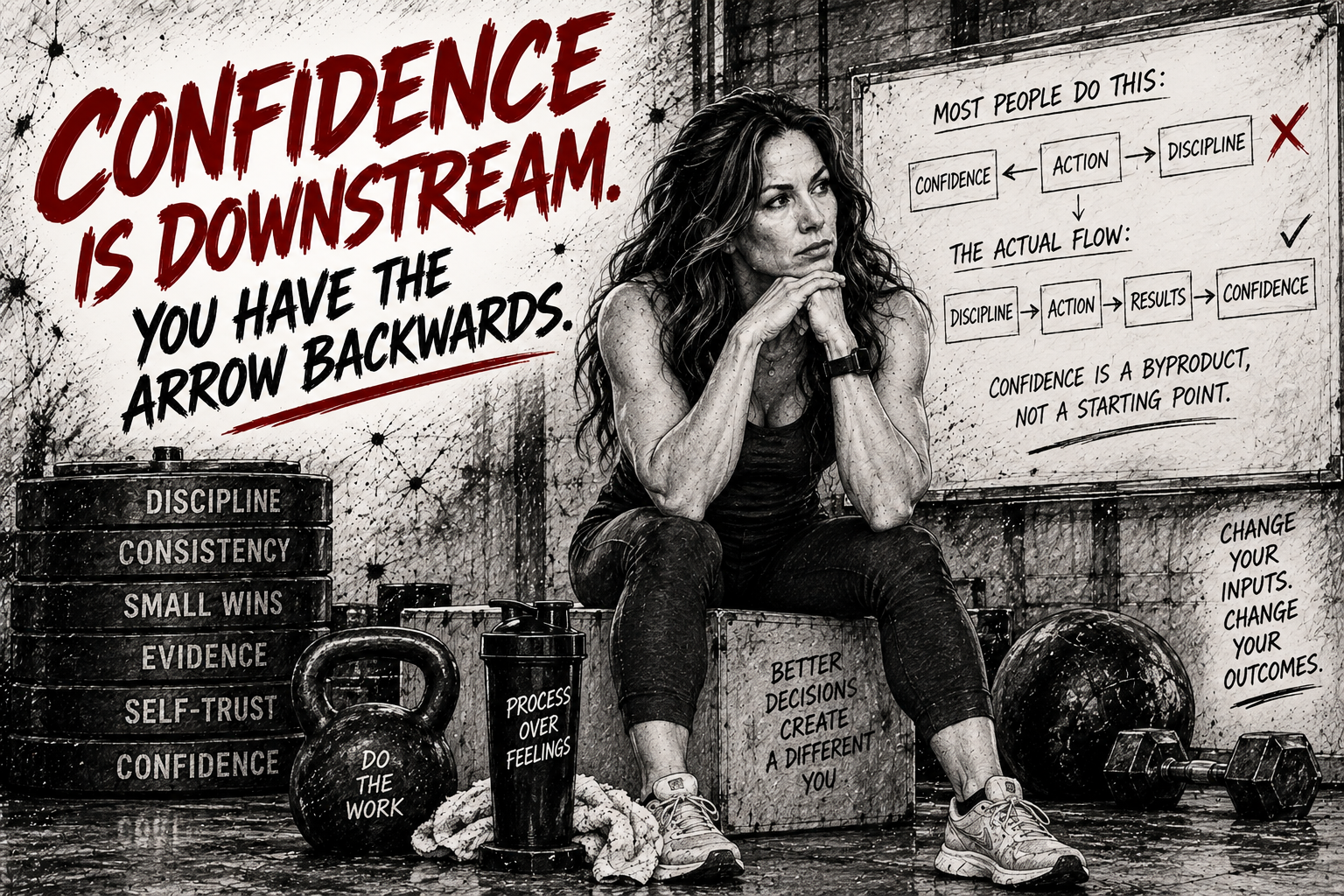
Confidence Is Downstream. You Have the Arrow Backwards.
Mindset
The advice is everywhere. Act confident. Believe in yourself first. Fake it till you make it. Walk in like you own the place.
The order matters in that advice. Confidence first, then results. Feeling precedes doing.
The research says the arrow points the other way. You do the thing, badly, repeatedly. Confidence shows up afterward as a receipt for work already completed. Trying to manufacture it in advance skips the only step that produces it.
What the confidence industry sold you
In the 1980s and 1990s, American schools and parents ran a decades-long experiment. The theory: if kids feel good about themselves, they'll perform better. So boost the feeling directly. Praise, participation trophies, affirmations.
In 2003, Roy Baumeister and three colleagues reviewed the results for the Association for Psychological Science. They emphasized objective outcomes rather than self-report, because people with high self-esteem tend to exaggerate their own successes. Their conclusion: the modest correlation between self-esteem and school performance does not show that high self-esteem causes good performance. Interventions designed to raise self-esteem produced no measurable benefits on outcomes. They found the benefits of high self-esteem fell into two categories: more initiative and pleasant feelings. That's it.
Feeling good about yourself did not make you better at things. Being better at things made you feel good about yourself. The experiment ran backwards for 20 years.
The mechanism that does work
Albert Bandura spent a career on a narrower concept: self-efficacy. Not "do I feel good about myself" but "do I believe I can execute this specific task."
He identified four sources. Watching others do it. Being told you can. Your physical state in the moment. And mastery experiences, which means having actually done it before. Of the four, mastery experiences are the strongest. A 2016 study of German preservice teachers found that changes in their self-efficacy were significantly predicted by mastery experiences, and that the other three sources mostly worked by feeding into mastery.
This matters because self-efficacy, unlike self-esteem, does predict performance. A 1998 meta-analysis of 114 studies covering 21,616 people found a weighted correlation of .38 between self-efficacy and work performance. That's a meaningful number in behavioral research.
So the chain runs: do the task, build the specific belief that you can do the task, perform better on the task. Confidence sits in the middle of that chain. The first step builds it. You cannot install it directly.
Why "fake it" feels like it works
Sometimes you act confident and things go well. You walk into the meeting with your shoulders back and nobody catches you.
Two things are happening. First, posture and presence change how others treat you, at least briefly. That's real and it's useful for a first impression. Second, and this is the part people miss, acting confident gets you to attempt the thing. The attempt is what builds the receipt. You didn't succeed because you felt confident. You succeeded because feeling confident tricked you into doing a rep.
Fine. If the trick gets you to the rep, use the trick. Just don't confuse the trick for the mechanism. The moment "fake it" replaces the reps instead of getting you to them, it stops working. You end up with a lot of shoulders-back and no track record.
The CrossFit version
You know this already from the gym, even if you haven't said it out loud.
Nobody gets confident under a barbell by deciding to be. You get confident at 225 by having pulled 225. Before that you pulled 205, and before that 185. The first time you hit each number you were not confident. You were nervous and you did it anyway and then you were slightly less nervous at that weight forever.
Your coach did not fix your snatch by telling you to believe in yourself. Your coach fixed your snatch by making you do 200 ugly snatches at 65 pounds.
The gym is the one place most people already accept that confidence is earned in arrears. Then they walk out and try to feel it first everywhere else.
What this means Monday morning
Stop trying to feel ready. Readiness is a result, not a prerequisite.
Pick the task you're avoiding because you "don't feel confident." Public speaking, cold outreach, a hard conversation, a heavier lift. Now find the smallest version of it you can complete this week. Not the version you're proud of. The version you can finish.
Do it. Write down that you did it. Do a slightly bigger version next week.
You will still not feel confident after the first rep. Or the third. Somewhere around the tenth, you'll notice you stopped dreading it. Nothing about your mindset shifted. You now have enough completed reps to trust.
The uncomfortable part
This is slower than the alternative. "Believe in yourself" takes 30 seconds and feels great. Building a track record takes months and feels like nothing until it suddenly does.
It's also less flattering. The confidence-first model says the problem is your beliefs. The competence-first model says the problem is your reps. Beliefs can be fixed with a podcast. Reps can only be fixed with reps.
But you already know which model produced everything you're actually good at. Look at your own life. Every skill you trust yourself on, you trust because you've done it. You didn't talk yourself into it. You worked yourself into it.
Do that again. On purpose this time.