Supplement Use Just Hit a Record High. The Law Behind It Turns 32 This Year.
OpEd
Supplement Use Just Hit a Record High. The Law Behind It Turns 32 This Year.
OpEd
A new industry survey puts usage at 77 percent of American adults, peaking in the 35 to 54 age bracket. Lab testing keeps finding bottles that don't match their labels.
The Council for Responsible Nutrition released its 20th annual consumer survey this month, and the headline number is the highest the trade group has ever recorded. Seventy-seven percent of American adults say they take dietary supplements. Usage peaks at 81 percent among adults aged 35 to 54. Women outpace men, 79 percent to 74 percent.
That 35 to 54 window is also when most women move through perimenopause.
The symptoms show up on schedule. Hot flashes. Sleep that breaks apart at 3 a.m. Weight that redistributes without a change in habits. Joint pain, anxiety, a brain that stalls mid-sentence. What does not show up on schedule is an explanation. Bloodwork comes back inside reference range. The appointment ends in eleven minutes.
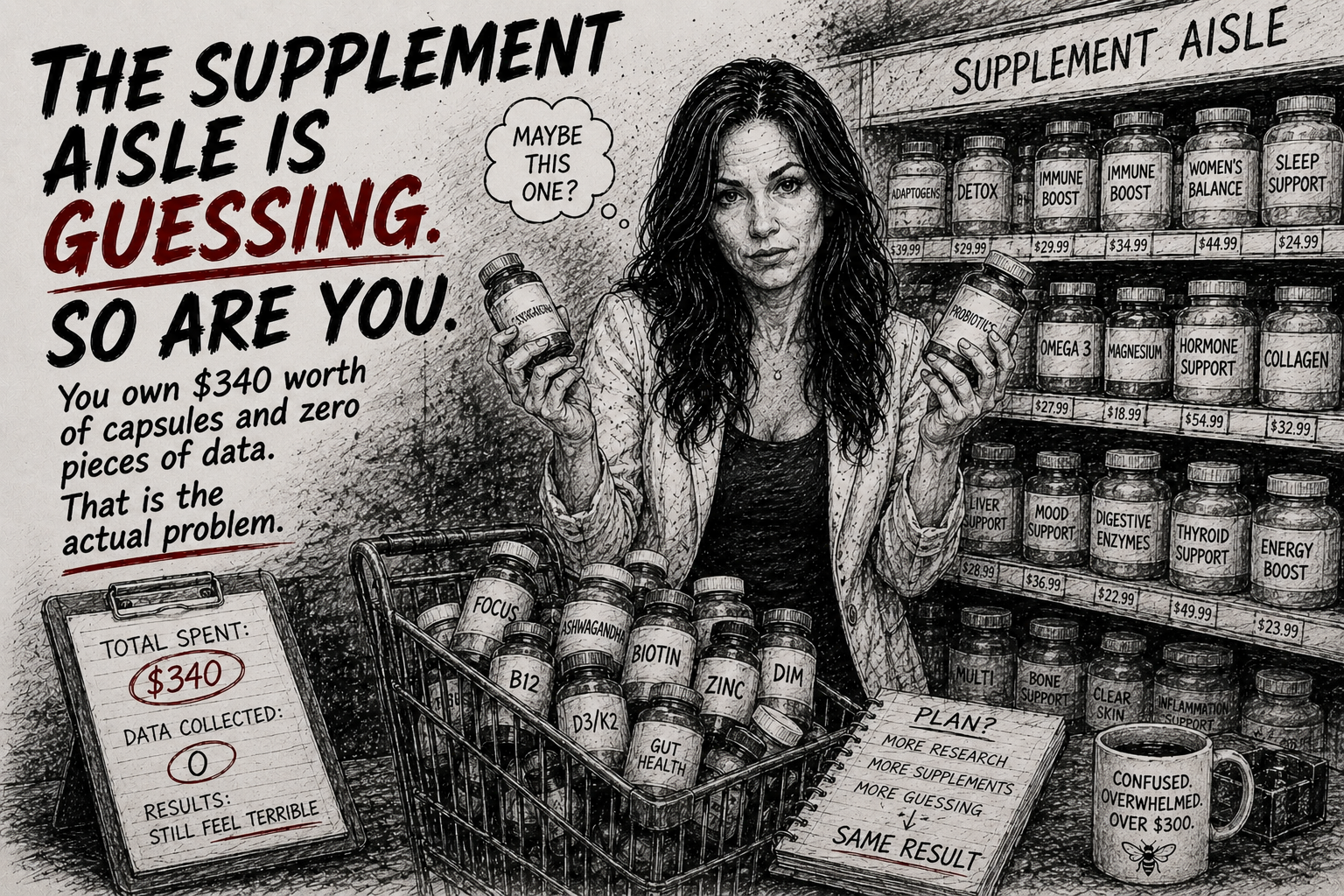
The supplement aisle, by contrast, is open all night and never tells anyone she's fine.
"Nobody buys a bottle of magnesium because she feels great," said Dr. Vickie Duncan, PhD, founder of the functional nutrition practice Be Limitless and author of Fix Your S#!T: The User Guide Your Body Never Came With. "She buys it because she's been told she's fine and she knows she isn't. That is not gullibility. That's a woman running out of options."
Duncan devotes a full chapter of the book to supplementation. Its title is "Signal Over Noise." Her position is not that supplements are useless. It is that most buyers have no way to know which category theirs falls into.
The 1994 problem
Supplements in the United States are governed by the Dietary Supplement Health and Education Act, passed in 1994. Under DSHEA, the FDA regulates supplements under a separate framework from prescription drugs and conventional foods. Manufacturers are barred from selling products that are adulterated or misbranded, and they are the ones responsible for evaluating the safety and labeling of what they sell before it reaches shelves. There is no pre-market approval step.
The market has grown by orders of magnitude since then. Analyst estimates for U.S. supplement sales in 2025 ranged from roughly $60 billion to nearly $69 billion depending on which research firm you ask, and the firms tracking the menopause-specific category disagree with each other by more than a factor of ten. Even the size of the industry is contested.
What testing actually finds
In 2023, researchers from Harvard Medical School, Cambridge Health Alliance, the University of Mississippi's National Center for Natural Products Research, and NSF International bought 57 sports supplements online and ran them through mass spectrometry. The results were published in JAMA Network Open.
Twenty-three of the 57 products, 40 percent, contained no detectable amount of the ingredient printed on the label. Among those that did contain it, quantities ranged from 0.02 percent to 334 percent of the stated amount. Only six products came within 10 percent of their own label. Seven contained at least one FDA-prohibited ingredient, including an unapproved drug sold in Russia, three withdrawn from European markets, and one never approved anywhere. Eleven percent of the products were labeled accurately.
The weight-loss category tested worse. A separate JAMA Network Open case series analyzed 30 weight-loss supplements marketed online with military discounts. Twenty-five, or 83 percent, had inaccurate labels. Twenty-four listed ingredients that testing could not find. Twenty-three percent contained something that appeared nowhere on the label.
A companion study of 44 weight-loss products sold on or near U.S. military bases found 82 percent with inaccurate labels and 91 percent scoring as "no-go" on the Department of Defense's own risk scorecard. Not one of the 44 carried a third-party certification seal.
"You're paying retail for a guess," Duncan said. "Then when you don't feel better, you assume your body is broken. Your body is fine. Your bottle was a rumor."
The menopause aisle specifically
Black cohosh is the most purchased botanical for menopause symptoms in the United States, according to the Menopause Society's 2023 position statement on nonhormone therapy. The same statement concludes there is insufficient evidence to support using it for hot flashes and night sweats, and does not recommend it. The society's panel also noted that placebo improvement rates in non-hormone trials for vasomotor symptoms run from 20 percent to 66 percent.
That range matters. Two out of three women in a trial can improve on a capsule containing nothing.
Black cohosh appears in a second body of research for a different reason. A 2024 JAMA Network Open analysis led by University of Michigan hepatologists used National Health and Nutrition Examination Survey data from 2017 to 2020 and estimated that 15.6 million American adults had taken at least one of six botanicals implicated in liver injury within the previous 30 days. The six were turmeric, green tea extract, ashwagandha, garcinia cambogia, red yeast rice, and black cohosh. For context, the researchers noted that figure is comparable to the number of U.S. adults prescribed an NSAID or simvastatin.
Data from the NIH-funded Drug Induced Liver Injury Network shows the share of drug-induced liver injury cases attributed to herbal and dietary supplements rose from 7 percent in 2004 and 2005 to 20 percent in 2013 and 2014. Most people in the Michigan survey reported taking the botanicals on their own, without a clinician involved.
"Natural is a marketing word, not a safety category," Duncan said. "Hemlock is natural. The liver does not read the packaging."
Washington is circling, slowly
Three supplement bills sat in committee as of this month. Senator Dick Durbin reintroduced the Dietary Supplement Listing Act in 2026, his third attempt to require companies to register products with the FDA and his last before retiring in January 2027. He has argued that DSHEA's omission of a registry left the agency without basic information about what is on the market. Representative Nick Langworthy introduced the Dietary Supplement Regulatory Uniformity Act on February 4, 2026, backed by industry trade groups, which would preempt the growing patchwork of state-level supplement laws.
The FDA held a public meeting on March 27, 2026, reexamining what qualifies as a "dietary substance" under DSHEA, with attention to peptides and other ingredient classes that did not exist in 1994. The comment period closed April 27. The agency received close to 1,000 submissions and is still reviewing them.
None of that changes what is on a shelf in Spring Hill this afternoon.
What Duncan tells clients
Her protocol is short and unglamorous.
Test before you buy. "Supplementing without labs is just expensive guessing with better branding," she said. Ferritin, vitamin D, B12, a full thyroid panel, and a metabolic marker set tell you what is actually low.
Require third-party certification. NSF Certified for Sport and USP Verified both confirm the contents match the label. The seal does not prove the ingredient works. It proves the ingredient is in there.
Fix food first. Protein, fiber, and sleep move more midlife symptoms than any capsule, and none of the three come with a label problem.
Keep the list short. "If your regimen has fourteen bottles, you don't have a protocol. You have a collection."
Duncan spent years being told her own labs were normal while she felt anything but. She went and got the doctorate. Her line about it is unprintable in most outlets and appears on the back of her book.
Next year's survey number will probably be higher. The testing data has not moved.
Dr. Vickie Duncan, PhD is the founder of Be Limitless and the author of Fix Your S#!T: The User Guide Your Body Never Came With.
This article is for information only and is not medical advice. Talk to a qualified clinician before starting or stopping any supplement, particularly if you have liver conditions or a history of hormone-sensitive cancer.