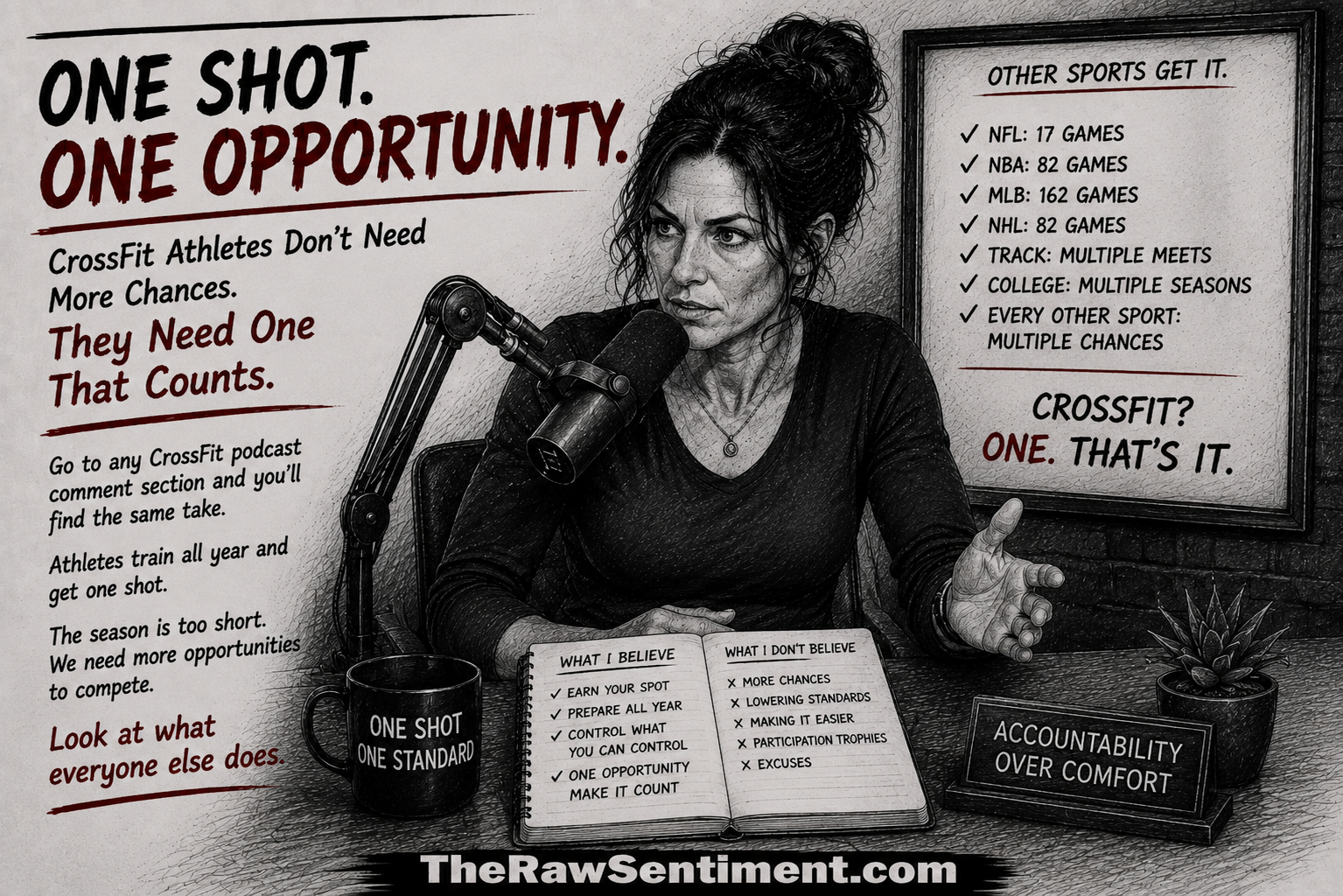
One Shot. ONE Opportunity
Op-Ed
CrossFit Athletes Don't Need More Chances. They Need One That Counts.
Go to any CrossFit podcast comment section and you'll find the same take. Athletes train all year and get one shot. The season is too short. We need more opportunities to compete.
Look at what everyone else does.
The Olympics run on a four-year clock
A sprinter trains roughly 1,460 days for a race that lasts under ten seconds. Miss the final by two hundredths and you wait until 2028. The 100 meter final has eight lanes. Eight. Everyone else goes home.
Weightlifters cut, peak, and total on one platform on one afternoon. A bad snatch day erases four years. Nobody in that warm-up room is arguing for more Olympics.
Elite marathoners race two marathons a year. Two. Kipchoge did not build a career by entering everything on the calendar. He built it by picking two dates and disappearing into training for the months in between.
American Ninja Warrior is worse
Across sixteen seasons, only 22 people have reached Stage 4. Total Victory has been achieved a handful of times. Geoff Britten and Isaac Caldiero got there in 2015. Drew Drechsel in 2019. Daniel Gil and Vance Walker in 2023.
Ninja athletes build private course setups in warehouses and barns. They train obstacles nobody has released yet. They train for a run that might last ninety seconds and might end at the first lache. Some of them go five years without seeing Vegas.
The show changed the format again. By Season 17, NBC scrapped the four-stage Mt. Midoriyama structure for bracket racing. Those athletes spent years training a course that no longer exists. They did not quit. They started training the new one.
Physical: 100 is one shot, forever
One hundred contestants. One winner. Roughly $230,000. No qualifying circuit, no points series, no ranking that carries over. You get cast or you don't.
Woo Jin-yong won season one. He's a CrossFit gym owner and a former snowboard cross athlete who competed on the FIS World Cup. He beat Olympic cyclists, an Olympic luger, and a mountain climber. He trained for years across two sports and got exactly one televised opportunity to prove it. He took it.
That's the model most of the fitness world operates on.
CrossFit already gives you more than any of them
Count what's actually on the calendar.
The Open runs three weeks with hundreds of thousands of entries. Anyone with a laptop and a barbell can enter. Then quarterfinals. Then semifinals or their equivalent. Then the Games. That's four separate competitive windows with real stakes, and the first one costs twenty dollars.
Then add the offseason circuit. Rogue Invitational. Wodapalooza. World Fitness Project. Dubai Fitness Championship. Hyrox if you want it. Local throwdowns most weekends in most cities. Team events. Masters and teen divisions with their own paths.
A gymnast gets one Olympic Trials. You get a season with four gates and a dozen optional events on either side of it.
Your body will not let you peak twelve times
This is the part that gets skipped.
A real peak takes a taper of seven to fourteen days and holds for about two to three weeks. Most athletes manage two, maybe three genuine peaks in a calendar year. That's it. The rest of the year you train through fatigue on purpose, because that's how adaptation works.
Building a strength quality takes an eight to twelve week block minimum. Fixing a real weakness takes longer. If you're competing every six weeks, you never finish a block. You taper, you compete, you recover, you repeat. Two years later your snatch is the same and your engine is the same and you've collected a shelf of fifth place finishes.
More competitions would not make the field deeper. It would make everyone permanently undertrained.
Say the real thing out loud
Most people asking for more competitions are asking for more money. Those are different problems.
Adding events does not add revenue. It splits the existing sponsorship dollars across more weekends, more travel, more entry fees, and more injury risk. Ask any athlete who chased the offseason circuit for three years what their net was after flights.
The actual asks are prize purses that scale past the podium, guaranteed appearance fees, media rights that pay the people on camera, and contract terms that survive a rule change. Those fights are worth having. "Give us more chances to compete" is not that fight. It's a softer version of it that lets everyone avoid the uncomfortable conversation about pay.
Train like it's four years, not four weeks
Here's the shift.
Stop treating the year as a series of tests. Treat it as one build with one exam. Pick your event. Work backward. Then call your shot. Give yourself a twelve week block on the thing that's costing you placements, and be willing to be bad at competitions during that block, because you will be.
Decide which offseason events serve the build and which ones just feel good. Most of them just feel good. A competition you enter because you're bored is a training week you spent on nothing.
Then show up in February with something that wasn't there last February.
The single-shot structure isn't a flaw in the sport. It's what makes the result mean anything. If the Games happened six times a year, nobody would clear their schedule for it. Scarcity is why anyone watches. Scarcity is why the win matters.
The Olympic sprinter accepts ten seconds every four years. The ninja accepts one run in Vegas. The Physical: 100 contestant accepts one season and no rematch.
You get four gates a year and a hundred optional weekends.
You're already fine. Go train.