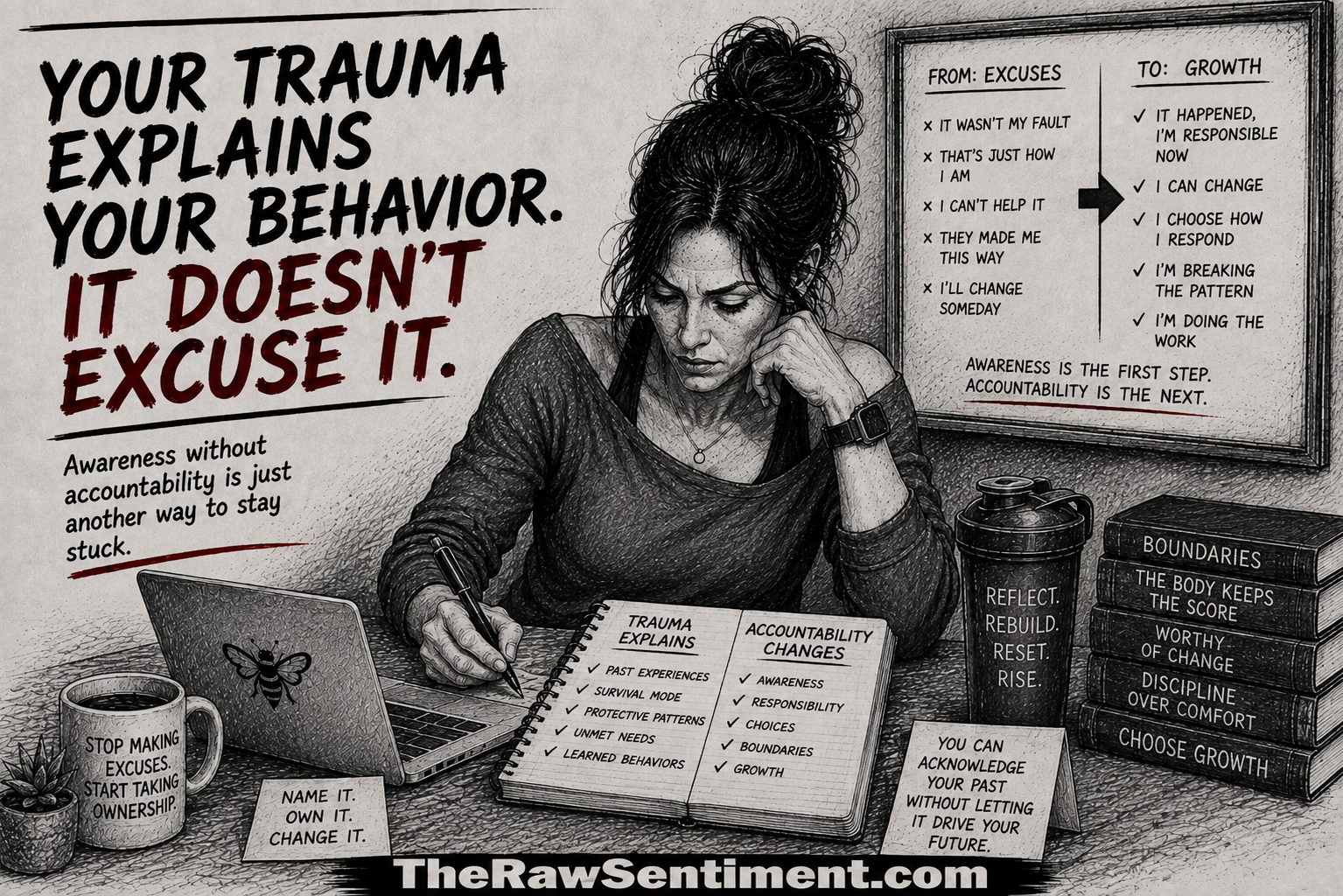
Your Trauma Explains Your Behavior. It Doesn't Excuse It.
Op-Ed
Someone loads the dishwasher wrong and you say something you can't take back. A coworker gives you feedback and you go cold for three days. A friend runs ten minutes late and you decide they don't respect you.
Then you explain it to yourself. Quietly. Automatically. You know why you're like this.
You probably do know. The reason is real. It still isn't a defense.
Common is not the same as excused
CDC data from the Behavioral Risk Factor Surveillance System, covering 2011 through 2020, found that 63.9% of US adults reported at least one adverse childhood experience. 17.3% reported four or more. That is not a small group hiding at the edges. That is most of the people at your gym, most of your coworkers, and a good portion of your family.
So the question is not whether something happened to you. Statistically, something did. The question is what happens at 6:40 on a Tuesday when your partner asks a normal question and you answer like it was an accusation.
Your history explains the reaction. It does not authorize it. People collapse those two things constantly, and the collapse is the entire problem.
The excuse never announces itself
Nobody says "I'm allowed to be cruel because of my childhood." That's too obvious to survive being said out loud.
What actually happens is smaller. You say you're just blunt. You say you have a low tolerance for nonsense. You say you don't trust easy, you don't do small talk, you're not a hugger, you shut down when people raise their voice. Each one is a description. Each one is also doing a job. The job is making the next incident feel inevitable.
Watch for the sentence that shows up right after you hurt someone. Not the apology. The sentence after the apology. "I'm sorry, I just get like that when I feel cornered." The first four words were the apology. Everything after was the defense attorney.
You've seen the gym version. Someone gets a no-rep on a squat depth call and the anger is four sizes too big for the event. Voice up, walking away, done for the day. Afterward it gets explained as passion, or standards, or a bad night. What actually happened is a coach with a clipboard tripped a wire that a coach with a clipboard did not install. The class saw it. The 19-year-old at the next rig learned that this is what adults do when corrected.
The version you point at yourself
Same mechanism, different target.
"I'm not a leader." "I don't do relationships." "I'm not the kind of person who finishes things." "I don't have the discipline."
These feel like honesty. They're doing something else. A belief like that protects you from testing it. If you never apply for the role, you never get told no. If you never commit to the twelve weeks, the twelve weeks never fail. The belief pays you in safety and charges you in years.
Run the invoice. Take one of those sentences and ask what it cost you in the last twelve months. Name the job you didn't apply for. Name the person you stopped texting. Name the program you quit in week three. If the sentence is simply true, the list should be short. It usually isn't.
The number that ends the argument
The strongest version of the excuse is that this is just how it goes. What was done to you gets done through you. You didn't pick it.
The research doesn't support that. Estimates of intergenerational transmission of child maltreatment land around 30%, with most reviews putting the range between 25 and 35 percent. That means roughly 70% of people who were abused as children do not go on to abuse their own. The elevated risk is real, and it's several times the base rate. It is also not a sentence handed down.
Seventy percent. Those are people who had every reason you have and did something else with it. Some of them did it in treatment. Some did it by deciding, at one specific moment, that the thing stops here.
What this is not
This is not "get over it." Nobody gets over it. The people who claim they did have usually just relocated it.
This is not an argument against therapy either. It's the opposite. Cognitive Processing Therapy, one of the treatments most strongly recommended for PTSD, runs about 12 sessions. Twelve one-hour appointments. In 2023, 58.7 million US adults had any mental illness and about 54% received any mental health service that year. That leaves roughly 27 million people who got nothing. If you're in that group, that's the highest-value thing you could change this month, and it beats anything else on this list.
And if you're in danger right now, or in crisis right now, skip all of this. Get help first. The rest is for the ordinary weekday version of the problem.
What to actually do
Apologize without the origin story. "I snapped at you. That was on me. I'm working on it." No backstory. The backstory turns your apology into their homework.
Measure the reaction against the event. If someone was five minutes late and you were cold for an hour, the extra fifty-five minutes came from somewhere else. That gap is the useful data. Write it down for two weeks. You'll find the same trigger showing up three times a week and you'll stop being surprised by yourself.
Give one person permission to name it live. "When I go quiet at dinner, say the word." Most people can't catch themselves in the moment. Most people can hear it from someone they trust.
Separate the two questions. "Why did I do that" is worth asking once. "What am I doing about it" is worth asking every time. The first question is comfortable, which is exactly why people move in there and stay.
The line
You didn't choose what happened to you. You choose what you hand to the people in front of you.
The person who catches your temper on a Wednesday night didn't do anything to you. Neither did the version of yourself that could have applied for the job. Both of them are paying a bill they didn't run up.
None of that is fair. It's still yours.