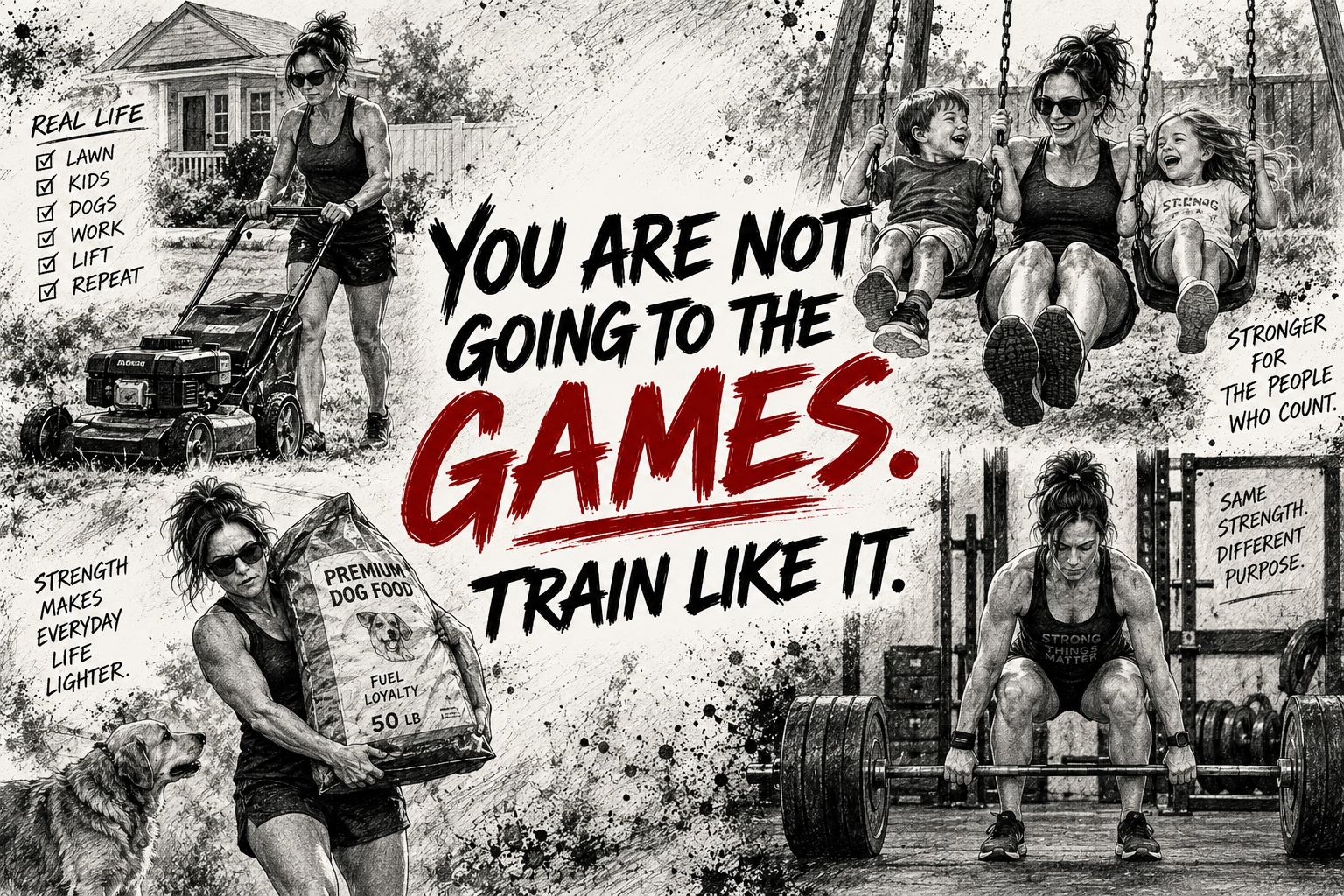
You Are Not Going to the Games. Train Like It.
Op-Ed
Around 254,000 people registered for the 2026 CrossFit Open. Sixty individuals made it to the Games in San José. Do the division: 0.024 percent. Roughly one in 4,200.
You are the other 4,199. So am I. This is not an insult. It is the single most useful fact in your training life, and most gyms pretend it does not exist.
The floor you actually compete on
Walk into any affiliate at 5:30 p.m. and listen. Someone is chasing a Quarterfinals spot. Someone is mad about their Open placement. Someone is doing extra accessory work because "the Games athletes do it." That last person will lose to a 40-pound bag of dog food in the parking lot next week and not connect the two events.
Here is the competition you are actually entered in. It runs every day for the rest of your life. Nobody announces it. There is no leaderboard, which is a shame, because you are already getting scored.
Events include: carrying two car seats and a diaper bag up three flights of stairs. Getting a 60-pound bag of concrete out of a truck bed. Sprinting after a toddler who has spotted a road. Loading a kayak onto a roof rack. Standing up off the floor at 78 without using your hands. Not dying.
That last one is not a joke. A Lancet study that followed roughly 140,000 adults across 17 countries found that every 5 kg drop in grip strength came with a 16 percent higher risk of death from any cause. Grip strength predicted death better than systolic blood pressure did. Your doctor checks your blood pressure every visit. Nobody has ever asked you to hang from a bar.
The clock is already running
After 30, you lose somewhere around 3 to 5 percent of your muscle mass per decade if you sit around. That is the polite version. The rude version comes from a quantitative review in Frontiers in Physiology: by 75, strength drops 3 to 4 percent per year in men and 2.5 to 3 percent in women, and strength goes 2 to 5 times faster than mass. You do not lose the muscle first. You lose the ability to use it.
Then you fall. More than one in four Americans 65 and older falls every year. In 2024, 43,020 of them died from it. Fall deaths in that age group are up 51 percent over ten years. The CDC's own prevention guidance names poor strength and balance as fixable risk factors. Squats, lunges, single-leg work, carrying odd objects. You already know what those are. You do them on Tuesdays and then post your Fran time.
What CrossFit was for before it became a sport
Greg Glassman's original definition was "constantly varied functional movement performed at high intensity." Functional was the important word. Deadlifts because you pick things up. Squats because you sit down and stand up. Overhead work because you put things on shelves. The Games came later, in 2007, with a few dozen athletes on a ranch in Aromas, California. Fitness was the product. The sport was the advertising.
Somewhere in the past two decades the advertising took over. Now a 34-year-old accountant with two kids spends 20 minutes a session on ring muscle-up progressions because 26.2 had them. He has never once needed a muscle-up. He has needed to carry a sleeping seven-year-old from the car to a bed roughly 600 times. Nobody programmed for that.
Reprogram for the life comp
You do not need a new gym. You need a new scoreboard.
Test things that happen. Farmer carry your bodyweight for 100 meters. Get up off your back in under three seconds. Dead hang for 60 seconds. Clean a heavy, ugly sandbag. Walk up a hill with a loaded pack. None of these will trend. All of them show up in real life within a month.
Scale toward strength, not toward the whiteboard. If the workout calls for chest-to-bar pull-ups and you cannot do one, a band that lets you fake the shape teaches you nothing. Heavy ring rows or strict negatives build what you lack. You scale to get stronger. Matching the rep count of the person next to you is a side effect, not the point.
Chase capacity, not placement. The 254,000 Open participants each got a percentile. That percentile says nothing about whether you can carry your groceries in one trip at 70. Track what does. Bodyweight back squat. Ten strict pull-ups. A mile under nine minutes. Three sets of 20 push-ups. Boring numbers. Boring is what durability looks like on paper.
Train the fall. Get on the floor every session. Roll, crawl, get down, get up. Turkish get-ups exist for a reason. The CDC's fall prevention program is built on strength and balance because that is what keeps hips out of the ER. Your box already owns the equipment. It is called the floor.
The counterargument
The comp crowd will say the sport gives people a reason to show up. They are right. A goal with a date on it beats a vague plan to age well. The Open works because it hands 254,000 people a deadline. Nothing wrong with that.
They will also say elite athletes raise the room's standard, and that watching the best drags everyone's floor up. Also fair. Plenty of people do both. Rich Froning is 39 and still competing, and he could probably outlift a Costco forklift.
But be honest about who you are. If you have kids, a job, a mortgage, and a lower back with opinions, your training should serve the decades in front of you, not a qualifier you will not make. Comp-style programming demands volume, skill work, and intensity you cannot recover from on six hours of sleep. It also eats time. Twenty minutes of muscle-up drills is 20 minutes you could have spent getting stronger at the thing that keeps you out of a nursing home.
The real podium
Here is the finish nobody prints on a shirt. You are 80. You get out of a low chair without grunting. You carry your own bag through the airport. You get down on the floor with a grandkid and get back up without a production. You have never broken a hip.
That is first place. Sixty people qualified for San José this year. Everyone else in the gym is qualified for this one, and it pays a hell of a lot better than $297,000.
Show up. Lift heavy. Carry awkward shit. Get off the floor. Repeat until dead, which, if you do it right, is a long damn time from now.